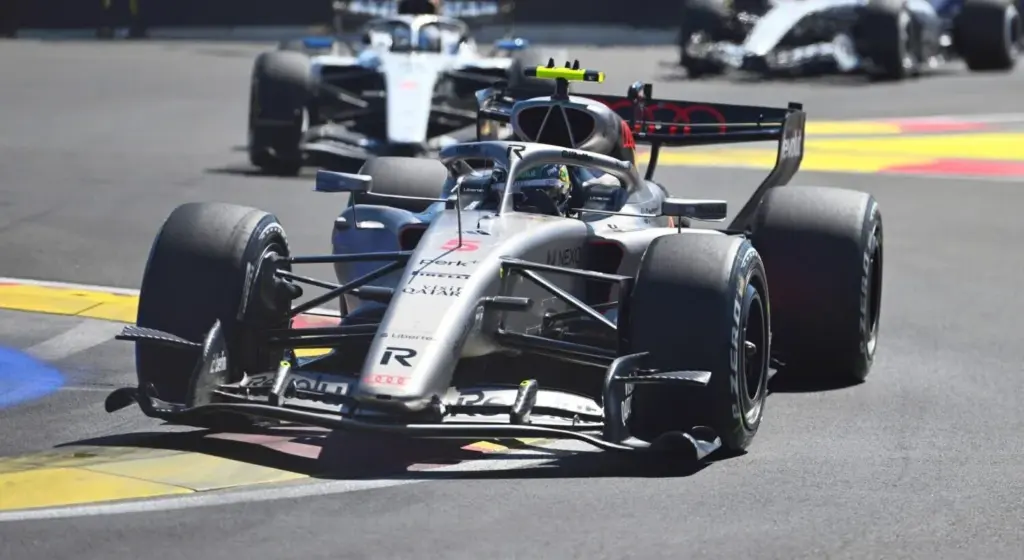
The Madring was presented as a new spectacular destination for F1, but for Gabriel Bortoleto, the new Spanish circuit proved to be particularly soporific.
Read more Carlos Sainz under fire after a difficult home Grand Prix in Madrid
The Brazilian experienced a Spanish Grand Prix largely devoid of action on Sunday, with fears about the difficulties of overtaking on the Madrid track ultimately confirmed.
After a weekend during which Formula 3 and Formula 2 had already shown how rare overtaking would be, F1 followed the same trend.
For Bortoleto, the race was even so monotonous that he admitted having trouble staying awake behind the wheel of his Audi R26.
A soporific Grand Prix
Asked about the lack of action on track, the Brazilian gave a particularly direct assessment: “Yes, I almost fell asleep too!”
However, this was not the only source of frustration for Bortoleto, whose race was largely dictated by circumstances rather than opportunities to make progress. The virtual safety car notably played a decisive role, especially for drivers on hard tires who could not take advantage of the neutralization to make a beneficial pit stop.
Bortoleto and Pierre Gasly then hoped that another race interruption could offer them an opportunity: “The race was ultimately determined by the virtual safety car, because we couldn’t stop on hard tires, so we just had to accept what happened. ”
Read more Lando Norris tests McLaren’s Hypercar the day after the Spanish Grand Prix
“The virtual safety car gains about 11 seconds, I believe, if our numbers are correct, reveals Gabi. After that, there was no more safety car, virtual safety car, or red flag. Pierre and I were both waiting for a red flag, maybe, to have a bit of luck and change tires, but it didn’t happen.”
Track to be reviewed
Once the neutralization ended, Bortoleto therefore had few options left and had to essentially wait for a new event to disrupt the race. The Madring was mainly criticized for its lack of overtaking opportunities, while drivers hoped to have at least one zone allowing real battles on track.
Despite the space available to design part of the track, the choice was notably made to favor the spectacular banked turn 12 and the urban character of the circuit, without creating a real zone conducive to overtaking.
Bortoleto acknowledges some qualities of the new Madrid circuit, but is much more critical regarding the spectacle it can produce: “It would be good if we had at least one place to overtake, but unfortunately, that’s not how they designed it. ”
“So there are good and bad parts on this circuit and, you know, it’s certain that from a racing point of view, it’s terrible, he said. I think it would be good that, for new circuits, we could come see the drivers and that we could give our opinion, because we know that on this type of track, overtaking will be very difficult.”
The assessment is all the more regrettable because Formula 1 has been trying for several years to favor circuits capable of producing more action on track. While the Madring undoubtedly has a particular visual identity, its first F1 race mainly highlighted the limits of its layout in terms of spectacle and overtaking.
Read more Alpine F1 turns to quantum computing to optimize its hybrid simulations