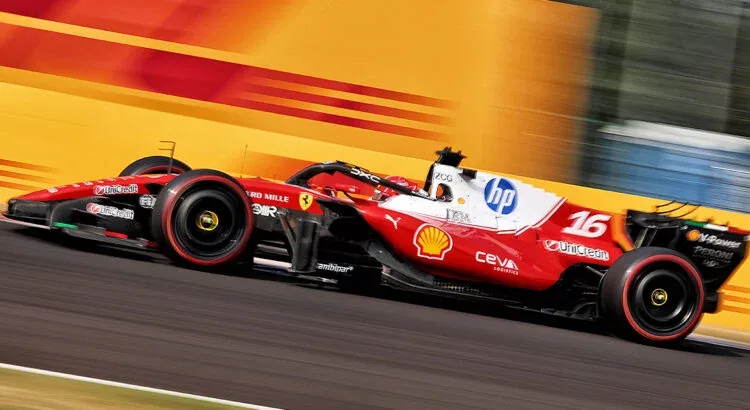
During the Hungarian GP practice, Ferrari tested a new energy management technique developed by Mercedes. Completely legal but extremely risky, this trick allows gaining the precious hundredths that make the pole position.
Read more Pirelli specifies its tire choices for Zandvoort, Monza, and Madrid
Mercedes may not have just found a few hundredths on its car. For several Grands Prix, the German team has also been using a very particular driving trick in qualifying, effective enough to attract the attention of its rivals.
According to The Race, Ferrari started testing this technique during the free practice of the Hungarian Grand Prix, with Charles Leclerc as well as Lewis Hamilton.
A regulatory loophole exploited by Mercedes
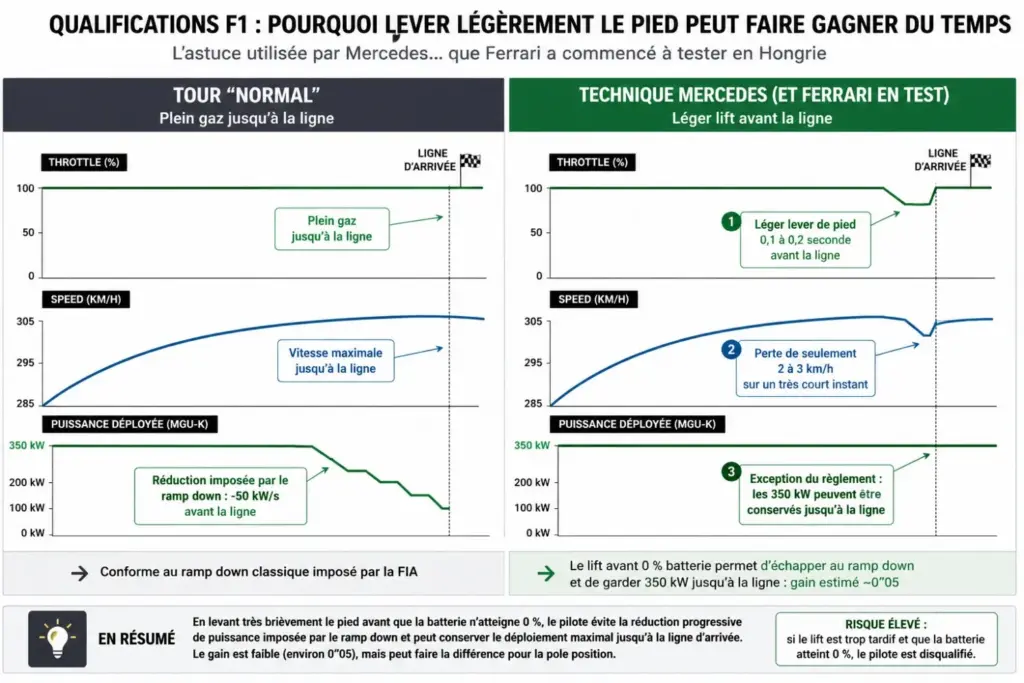
It all depends on how the electric power is delivered approaching the finish line of a flying lap.
The regulations normally require that the power supplied by the MGU-K decreases progressively when the battery is near depletion. This reduction must follow a slope (“ramp down”) defined by the FIA, which forces teams to start reducing power even before the line.
However, Mercedes discovered that an exception in the regulations allows escaping this constraint.
If the driver slightly releases the accelerator before the battery is completely empty, the limitation no longer applies. He can thus maintain the maximum power of 350 kW almost up to the line, benefiting from a slightly higher speed at the moment the timer stops.
The gain is small — about 0.05 seconds according to estimates — but it can make all the difference in a grid where gaps are now measured in thousandths.
Ferrari started its tests
Telemetry data from Friday in Hungary shows that Ferrari began experimenting with this procedure.
Approaching the line, Charles Leclerc briefly releases the accelerator, exactly as George Russell and Andrea Kimi Antonelli have been doing at Mercedes for several races.
Read more Toto Wolff still does not rule out the possibility of Verstappen at Mercedes
The tests were carried out with both drivers to evaluate the potential benefits of this strategy.
However, Ferrari ultimately chose not to use it in qualifying.
Why Ferrari gave up in Hungary
The Hungaroring simply was not the ideal track.
The Hungarian circuit is considered “energy rich”, meaning that drivers still have enough electric energy in the last part of the lap. Under these conditions, the interest in extending the maximum deployment up to the line becomes much more limited.
Conversely, on circuits where the available energy is lower and where the finish line is just after the last corner — like Silverstone, Spa-Francorchamps or Melbourne — the benefit is much more significant.
Mercedes itself did not use this technique in qualifying in Hungary.
A bet that can cost very dearly
If Ferrari continues its tests, it is because a few hundredths can now completely change the order of the grid.
In Hungary, before his penalty for impeding Oscar Piastri, Lewis Hamilton had thus missed the pole position by only 0.012 seconds to Lando Norris.
But this technique carries a major risk.
The driver must imperatively release the accelerator before the battery is completely empty. If he does it a fraction of a second too late, the progressive reduction imposed by the regulations will not be respected.
The consequence would be particularly severe: a disqualification.
That is why Mercedes has worked extensively on this procedure in its simulator before using it on track, with drivers even receiving an audio signal in their earpieces indicating precisely when to lift the foot.
Ferrari now seems to be following exactly the same path. The tests carried out in Hungary suggest that the Scuderia could soon use this technique on circuits where the potential gain is greater… provided the risk is worth it.
Read more Max Verstappen explains his decisive overtake on Hamilton