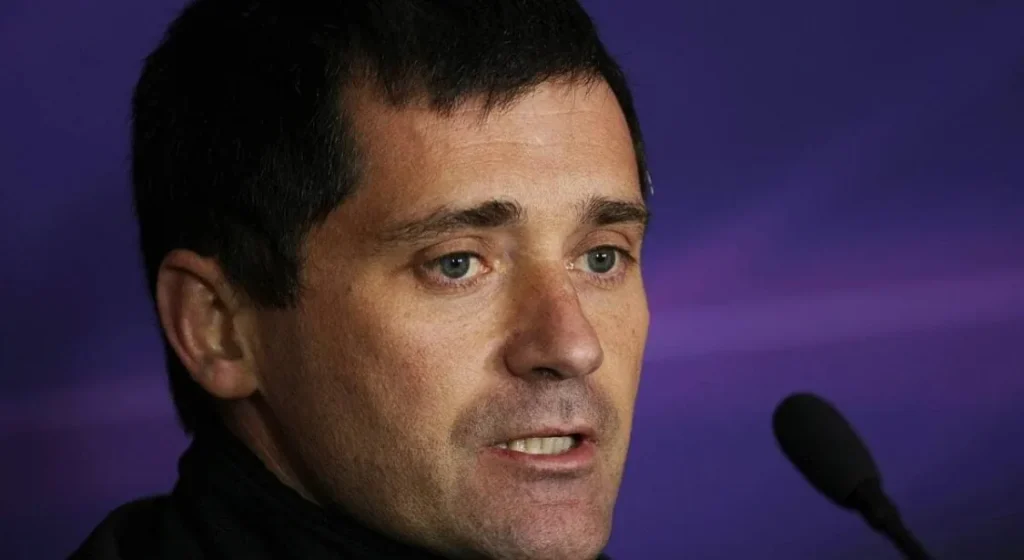
Spanish engineer and consultant Toni Cuquerella has proposed a simulation aimed at completely eliminating the “super clipping” phenomenon in Miami to make overtaking more natural.
Read more More overtakes in 2026: a better show than previous seasons?
A former member of several Formula 1 teams between 2006 and 2012 (HRT, Super Aguri, Sauber), then briefly at Ferrari in 2015-2016, Cuquerella shared a simulation on X suggesting that F1 could correct many problems observed during the first three races through a few targeted technical adjustments.
His proposal is based on several modifications to the power unit parameters: reducing the maximum power delivered from 350 kW to 200 kW, maintaining energy recovery at 350 kW, decreasing the maximum recharge from 9 MJ to 6 MJ, halving the “slew rate” from 100 kW/s to 50 kW/s, as well as a rebalancing between the MGU-K and the internal combustion engine (ICE) from 50/50 to 36/64.
Overall performance minimally impacted
According to his simulation, these changes would allow a top speed of around 328 km/h before braking — compared to 338 km/h currently — which is only 10 km/h less, while totally eliminating super clipping, even on a circuit with a very long straight like Miami.
Despite these adjustments, the performance loss would be limited to about 1.4 seconds per lap, with the cars remaining more than eight seconds faster than Formula 2.
Read more Engineer Cédric Michel-Grosjean operational from Miami alongside Lewis Hamilton
However, such an evolution would be almost impossible to implement in the short term, as modifying the balance between the internal combustion engine and the electric motor to this extent would require a complete redesign of the power unit architecture.
Taking driver feedback into account
This simulation nevertheless offers interesting insight into potential solutions to solve a problem that is currently fueling many debates.
Furthermore, Carlos Sainz, also a director of the Grand Prix Drivers’ Association, called on the FIA and the teams to “listen to the drivers” before their meeting on April 9. Speaking at Suzuka, he criticized the tendency to rely solely on team feedback, believing that it does not reflect the reality experienced on track.
He notably pointed out speed differences of up to 50 km/h, judging that the current situation does not correspond to a real race, and warning that these differences create unpredictable and potentially dangerous situations for drivers, as seen with Oliver Bearman in Japan.
Read more Grands Prix postponed or cancelled: sport is powerless when geopolitics gets involved…