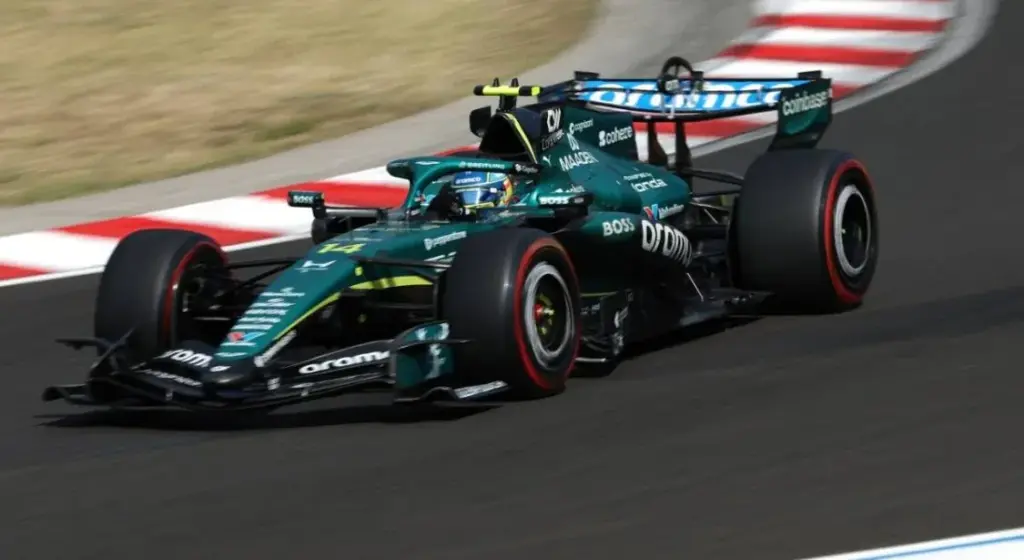
The failure of the active aerodynamics on Fernando Alonso’s Aston Martin at Zandvoort is pushing Pirelli to consider new safety measures.
Read more Allan McNish highlights Nico Hülkenberg’s miraculous rescue at Zandvoort
An incident that went relatively unnoticed during the Dutch Grand Prix could have consequences on the Formula 1 regulations. Pirelli is indeed considering reopening discussions with the teams and the FIA regarding the procedure to follow when a car experiences a failure of its active aerodynamic system.
The Italian manufacturer now has a concrete case to analyze after the problem encountered by Fernando Alonso at Zandvoort. During the Sprint qualifying, the Spaniard suffered a failure of the Straight Line Mode (SLM) on his Aston Martin.
His rear wing did not adopt the expected configuration on the straights, significantly increasing the drag of his car. Alonso ultimately recorded the slowest time of the 22 drivers entered.
Alonso’s problem provides valuable data to Pirelli
Introduced with the new 2026 regulations, active aerodynamics allow cars to modify the configuration of their wings depending on the different sections of the circuit.
The Straight Line Mode is specifically designed to reduce drag on the straights. This technology became necessary due to the new generation of power units, whose power is now equally split between the internal combustion engine and the electric part.
With conventional fixed wings, the levels of drag and downforce would have been too high. But this new architecture also has a direct influence on the tires.
Pirelli tires were notably developed taking into account a reduction of aerodynamic loads on the long straights when the SLM is activated. The failure encountered by Alonso thus offers a rare opportunity to measure the real consequences of a malfunction.
“We are analyzing this because it is interesting for us to collect this type of data, since this kind of situation does not happen very often,” explains Simone Berra, Pirelli’s chief engineer.
Pirelli wants to compare simulations to reality
Alonso’s incident is not the only element available to the Italian manufacturer. Several teams have deliberately experimented with different configurations during free practice.
“We want to understand the difference between the simulations we received and the real data we have,” Berra continues.
“It was not only about Fernando. During FP1, other teams conducted tests under different conditions with rear or front wings that were not fully open. We are therefore analyzing this data and it is important for us to have these different scenarios.”
This information should allow Pirelli to better understand the stresses experienced by its tires when a car does not reduce its downforce as expected at high speed.
And the subject could quickly go beyond simple technical analysis to become a real safety issue.
A driver could be forced to return to the pits
If a similar failure occurred during a Grand Prix, the FIA could theoretically consider that the car represents a risk and impose an intervention.
Read more George Russell will also have to serve another engine penalty this season, but when?
One of the solutions considered would be the use of the black flag with an orange disc, sometimes called the “meatball flag”. This flag forces a driver to return to the pits when a technical problem on their car is considered potentially dangerous.
In the case of an SLM failure, the driver could thus be forced to stop for repairs, or even retire if the problem cannot be fixed.
Such a procedure will however not be introduced during the second part of the 2026 season.
Pirelli ready to reopen discussions with the FIA
The subject had already been studied earlier in the season before being finally closed. Alonso’s incident could however push the different parties to resume discussions for 2027.
“We can reopen discussions, since they had already been started mid-season,” confirms Berra.
“I think it will concern next season more. We will probably decide to resume discussions with the teams and the FIA.”
For now, no regulatory changes are therefore under consideration for the upcoming races.
“At the moment, there is no open point on this subject. The file is closed. But for the future, I think we can discuss it again.”
An SLM failure considered “very critical”
Pirelli has also identified scenarios likely to cause the greatest stresses on the tires.
For the rear axle, the most concerning case would be the one encountered by Alonso, with a rear wing that does not open as expected. Regarding the front axle, the most critical situation would occur when both wings remain simultaneously in their configuration generating more downforce.
Berra warns, however, that no system failure should be considered trivial.
For Pirelli, any malfunction of the Straight Line Mode can become “very critical”, especially because the 2026 tires were designed anticipating a decrease in aerodynamic loads on the long straights.
The incident encountered by Alonso at Zandvoort could thus serve as the first real case study. And if it confirms Pirelli’s concerns, the FIA could be led to impose from 2027 the return to the pits of a car whose active aerodynamics present a failure.