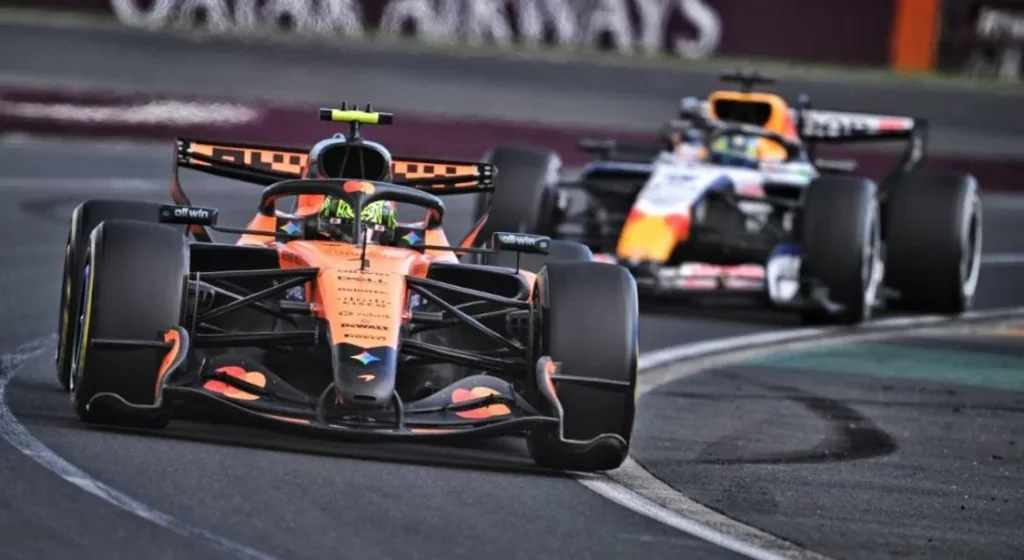
The new single-seaters introduced in 2026 competed in their first race in Australia. But Lando Norris fears that speed differences related to electrical energy will cause a major accident.
Read more Isack Hadjar frustrated after his retirement: «I knew the engine was going to blow up»
The Australian Grand Prix marked the racing debut of the new generation of single-seaters introduced by the 2026 regulations. At the Albert Park circuit, these cars immediately provided an animated spectacle with numerous overtakes, especially in the opening laps.
At the end of the event, Mercedes secured a one-two finish with George Russell winning ahead of his teammate Kimi Antonelli, while the battle for the lead with Charles Leclerc enlivened the start of the race.
But behind the spectacle, some drivers quickly expressed their concerns about the behavior of these new cars, particularly due to the very complex energy management.
Battery management disrupts overtaking
The 2026 regulations give a much more important place to electrical power in the power units. Drivers must constantly harvest and deploy energy throughout the lap, which can cause very significant performance gaps between two cars.
According to Lando Norris, these variations create particularly dangerous situations during on-track duels.
“It’s chaos, there’s going to be a big accident,” the McLaren driver warned the media.
The Briton explains that drivers sometimes find themselves in an uncomfortable position, where they almost feel like they are waiting for an incident to occur.
“It’s a shame to get to this point: we’re just driving around waiting for something to happen and for everything to go very wrong.”
Worrying speed gaps
Norris also criticizes the artificial nature of the overtakes caused by variations in energy delivered by the hybrid engine.
Read more Scare at the start of the Australian GP: Franco Colapinto narrowly avoids a huge accident
“It’s frustrating, it’s very artificial, because everything depends on what the power unit decides to do and what it sometimes does randomly.”
In certain situations, drivers can lose several positions in a few seconds without being able to defend themselves: “You can get overtaken by five cars at once and be unable to do anything.”
A serious risk for drivers and spectators
For the reigning world champion, the real problem mainly concerns the speed gaps that can appear in certain areas of the circuit.
“Depending on what the drivers do, there can be a 30, 40 or even 50 km/h speed difference.”
Such a differential could have very serious consequences in the event of a collision: “When someone hits another car at that speed, the car can take off and go over the barriers.”
Norris doesn’t even rule out serious injuries: “You can get very badly hurt and maybe hurt other people. It’s a pretty horrible thing to imagine.”
Despite these criticisms, the McLaren driver acknowledges that the situation is likely to last. Manufacturers have invested heavily in the new power units and it will be difficult to quickly modify the technical regulations.
For now, drivers will therefore have to learn to deal with these new single-seaters, even if some already fear that safety could be put to the test during the season.
Read more Lewis Hamilton sees the positive after a «fun race» in Australia