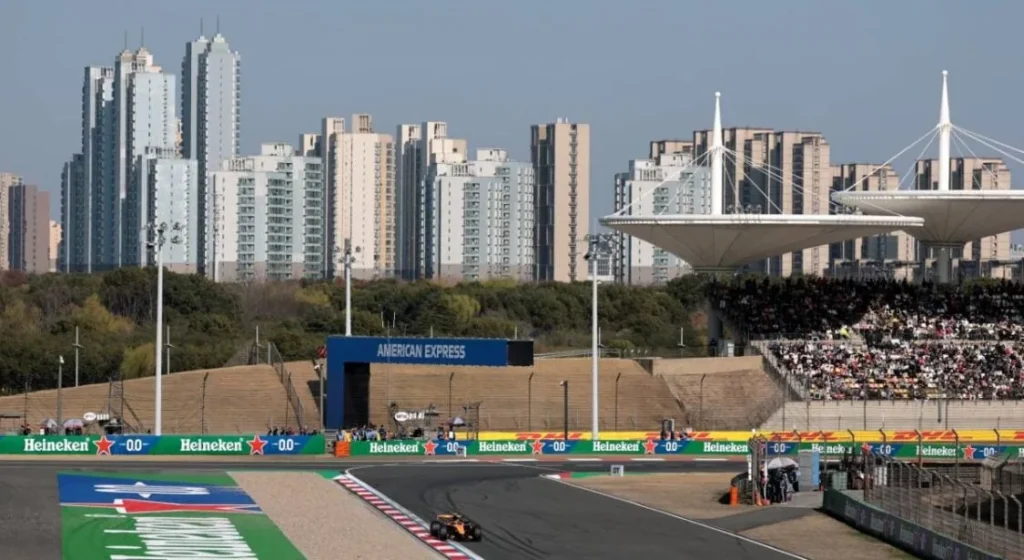
Tire management could be one of the key factors of the Chinese Grand Prix. According to Pirelli, the graining phenomenon risks strongly influencing strategies on the Shanghai circuit.
Read more Catastrophe for McLaren: Norris and Piastri don’t even start in China
As the Grand Prix held on the Shanghai circuit approaches, Pirelli has highlighted the main technical challenge that Formula 1 teams will have to face: graining.
This phenomenon occurs when tire temperature remains below their ideal operating window. Under these conditions, the tire surface deteriorates and small pieces of rubber break off before sticking to the tread. Result: grip decreases significantly, making the car more difficult to control.
On this Chinese track, this problem is particularly pronounced. The circuit’s long curves, and notably the famous Turn 1, exert significant pressure on the front tires, especially on the front left.
A particularly demanding circuit
Mario Isola, head of Pirelli’s motorsport program, is not surprised to see this phenomenon appear in Shanghai.
“The tires are working quite well, but graining is not a surprise here. The front left tire is under a lot of stress, especially because of the first corner which is extremely long.”
According to him, once graining appears, it takes several laps for the tires to regain their optimal performance: “If graining starts, it takes a bit of time to clean the tire surface. But that’s part of the show.”
Isola even points out that some observers see a positive aspect in this phenomenon.
“I’ve heard some people say they were happy to see graining, because it introduces a bit of degradation and therefore more uncertainty.”
A one-stop strategy expected
The race, 56 laps long, should in principle be played out on a one-stop strategy, as is often the case on this circuit.
The most classic approach should consist of starting with medium tires before finishing the race with hard compounds. However, another strategy could appeal to some teams.
Read more Fernando Alonso forced to retire in China after a worrying physical alert
According to Isola, the performance gap between the different options remains extremely small.
“The medium-hard strategy is probably the one most teams will choose. But the soft-hard option is very close in terms of total race time.”
The soft tire gamble
This proximity between strategies could encourage some drivers to take a risk at the start by opting for soft tires.
“Starting with soft tires is possible. This allows for a more aggressive start and then stopping earlier to try and get out of traffic.”
Such a strategy could prove particularly useful for drivers starting in the middle of the pack and looking to gain positions quickly.
Temperature, a decisive factor
Another element could influence the impact of graining: track temperature. According to Isola, soft and medium tires should behave quite similarly regarding the graining phenomenon, even if the softest compounds might suffer slightly more.
“I expect fairly similar behavior between soft and medium tires in terms of graining, with perhaps a bit more on the softs, but the difference shouldn’t be huge.”
The hard tires should, for their part, offer superior consistency over the duration of the stint.
With very close strategies and a potentially decisive graining phenomenon, tire management could well become one of the key elements to securing victory in Shanghai.
Read more Kimi Antonelli triumphs in China, Lewis Hamilton finally clinches his first podium with Ferrari