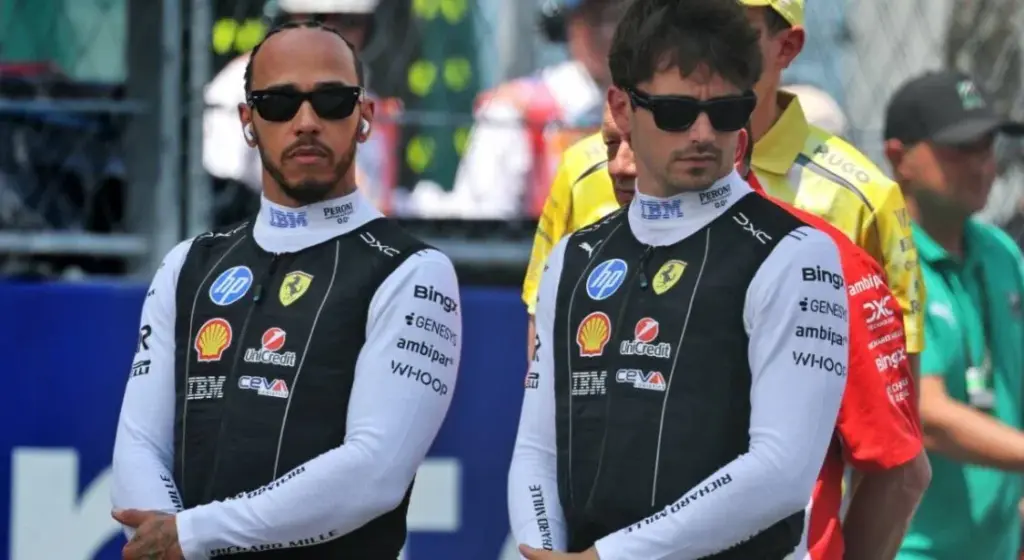
The performance difference between the Ferrari drivers has reignited discussions around an unusual choice made by the British star before Montreal: setting aside the simulator.
Read more The TV schedule of the Monaco Grand Prix
The Canadian Grand Prix left mixed impressions within Scuderia Ferrari.
On one hand, Lewis Hamilton achieved his best result since arriving in Maranello with a solid second place behind Kimi Antonelli.
On the other hand, Charles Leclerc had a much more complicated weekend, finishing more than thirty seconds behind his teammate.
Lack of correlation
After Miami, the English champion explained that the virtual tool did not bring him the expected benefits. According to him, the behavior of the SF-26 in the simulator did not sufficiently reflect what he then found on the track.
Canada therefore served as a full-scale test. By prioritizing his feelings and experience rather than long virtual preparation sessions, Hamilton achieved his best result of the season.
However, the seven-time world champion does not condemn the simulator: “I could use it after races to help the team improve the correlation between the real car and the virtual car.”
But when it comes to preparing for a Grand Prix weekend, his opinion now seems much more clear-cut: “Will I use it to prepare for another race? Probably not. There are simply too many risks. I’m probably better without it, that’s my old school side.”
Read more What weather for the Monaco Grand Prix?
Opposite reading
The Briton recalls that during a large part of his successful career, the simulator did not occupy as important a place as it does today in driver preparation. Faced with this situation, some have naturally been tempted to establish a direct link between Hamilton’s abandonment of the simulator and the gap observed with Leclerc in Montreal.
But the Monegasque categorically rejects this interpretation. According to him, the performance differences observed in Canada cannot be explained by a simple choice of preparation or by different settings.
“There is nothing in the performance we saw today that is due to a setting,” Leclerc believes. A setting can represent a tenth, but in the end, it’s not much. Not having confidence on a day like this, I simply didn’t push enough compared to Lewis.”
This analysis highlights an essential aspect of modern driving: with similar mechanical performance, the ability to fully exploit the car often depends on the driver’s feeling and confidence at the limit.
Monaco as the judge
The next meeting could precisely reshuffle the cards. The Monaco Grand Prix comes at the right time for Ferrari.
Leclerc will race at home on a circuit where confidence, precision, and commitment matter more than pure power. Yet, the main weakness of the SF-26 remains its lack of top speed, a handicap much less penalizing in the narrow streets of Monte Carlo.
In the championship, Leclerc still holds the advantage over Hamilton, but the gap between the two drivers is now only three points. In this context, Monaco could well be an important turning point in the internal dynamics of the Scuderia.
Read more Mercedes considered a suspension for Hamilton and Rosberg after their clash in 2016