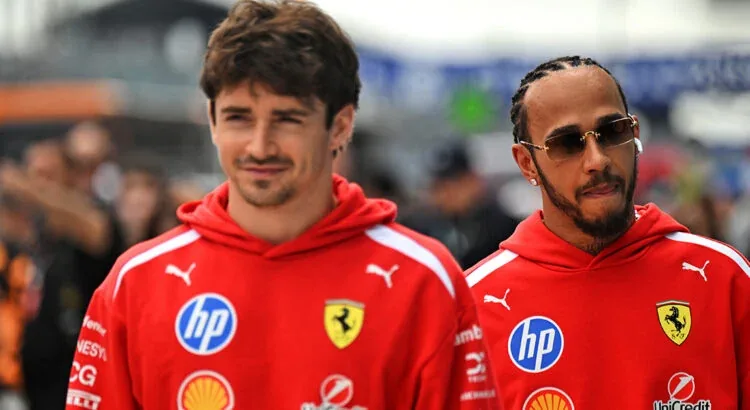
Ferrari suffers a clear power deficit compared to Mercedes and Red Bull-Ford. Analysis of a performance crisis that only the F1 regulator seems able to resolve.
Read more Bearman eager to race in Monaco: «We will finally be able to drive more naturally»
The Canadian Grand Prix acted as a revelation for the Scuderia drivers. Behind the dominance of Andrea Kimi Antonelli’s Mercedes, the assessment is unequivocal at Ferrari. Lewis Hamilton, usually accustomed to the top, conceded ten seconds gap at the finish, directly questioning the pure performance of his car.
The seven-time World Champion describes a precise mechanical frustration, visible in the telemetry:
“If you remove this power deficit, we are in the fight against those guys. But unfortunately, that is not the reality today. At times, I tell myself: ‘I need more power one way or another,’ because I manage to hang on or keep their pace in the corners, but I can’t push the pedal further. And you just see them pull away on the straights.”
The 2026 Ferrari engine under scrutiny
Even activating the most aggressive energy deployment modes is not enough to compensate for the lack of raw thrust of the Italian team. A finding shared identically by Charles Leclerc. The Monegasque goes even further in the hierarchy by admitting that the 2026 Ferrari engine is currently lagging behind the new Red Bull-Ford power unit:
“I would be surprised if we are not [eligible for upgrades], because I clearly see that sometimes on the straights, we lack a bit compared to the Mercedes power unit or even Ford’s.”
ADUO: The FIA’s regulatory lifeline
Faced with this glaring disparity from the first events of the season (Melbourne, Shanghai, Suzuka), the hopes of the Scuderia do not rest solely on internal developments, but on an FIA leveling mechanism: the Additional Development and Upgrade Opportunities (ADUO) system.
This mechanism, which came into effect precisely after Montreal, provides additional development windows for engine manufacturers whose internal combustion engine shows a statistically significant performance deficit.
Read more In all modesty, Fernando Alonso is still convinced he is the best Formula 1 driver
The optimization dilemma
For Charles Leclerc, the current hierarchy remains complex to decode. The introduction of upgrade packages, like in Miami, intertwines with the learning curve of extremely complex power units. The team refuses to panic, preferring a systemic analysis:
“I just think we are still at a point in the season where teams are just trying to understand how to maximize the whole system, which is really very complex. I don’t think we will ever reach 100% optimization with this kind of car.”
Monaco, the exception for the 2026 Ferrari engine?
While the long-term diagnosis looks difficult to close the gap with Mercedes, the calendar offers short-term relief.
The next Grand Prix in Monaco could mask Ferrari’s shortcomings in top speed.
On the urban track of the Principality, pure power gives way to aerodynamic efficiency at low speed and mechanical grip. A terrain where Hamilton hopes to reverse the trend:
“Monaco should be fun. It’s the only circuit where power is not king. There, it’s purely about the car’s performance. I think our car could be really strong there.”
It remains to be seen if the precision of the Ferrari chassis in the streets of the Principality will be enough to make us forget that, on the majority of championship circuits, the Scuderia is currently chasing the horsepower of its rivals.
Read more Why Max Verstappen is disadvantaged by the new F1 regulations