The first qualifying of the 2026 season at the Australian Grand Prix has revived criticism of the new generation of F1. Between extreme energy management and distorted fast corners, drivers are worried about the show.
Read more What time does the 2026 Formula 1 Australian Grand Prix start?
The first qualifying session of the season, held during the Australian Grand Prix on the Albert Park circuit, confirmed a trend already observed during winter testing: the new 2026 single-seaters are profoundly changing the way of driving… and not necessarily for the better.
Certain portions of the Melbourne track perfectly illustrate this phenomenon. A section of about one kilometer includes two iconic corners of the circuit: Turn 6, a fast and blind right-hander at the entry, and then Turn 9, formerly spectacular because it was approached at very high speed.
With the new F1 cars, this sequence has lost much of its intensity. While Turn 6 remains demanding, Turn 9 is now approached much slower than before. Drivers must indeed lift off well before the corner entry, not because of a lack of grip, but for energy reasons.
Energy management at the heart of the problem
The new regulations impose extremely strict energy management between the internal combustion engine and the electrical system. In certain areas of the circuit, the engines even operate in generator mode to recharge the battery. As a result, the cars slow down significantly while still at full throttle.
In Melbourne, the difference is spectacular. During his pole position lap, George Russell reached a top speed comparable to that recorded last year by Lando Norris in the same area. But approaching Turn 9, the 2026 Mercedes was about 30 km/h slower than the McLaren of the previous season.
And above all, this slowdown is not linked to late braking or a loss of aerodynamic downforce. Drivers simply lift off to optimize energy recovery and ensure enough electrical power in the following straights. In practice, this means they are no longer even attacking these corners at the limit.
Mercedes dominates despite these constraints
In this very specific technical context, Mercedes largely dominated qualifying in Melbourne. Russell took pole position ahead of his teammate Kimi Antonelli, giving the German team a complete front row.
The competition was clearly distanced, even though Isack Hadjar managed to place his Red Bull in third position.
Mercedes’ advantage seems to come notably from a particularly efficient exploitation of the energy deployment system. Some rival cars were losing up to 10 km/h at the end of the straight, due to being unable to deliver as much electrical power.
Read more Disaster for Oscar Piastri: crash even before the start of the Australian Grand Prix
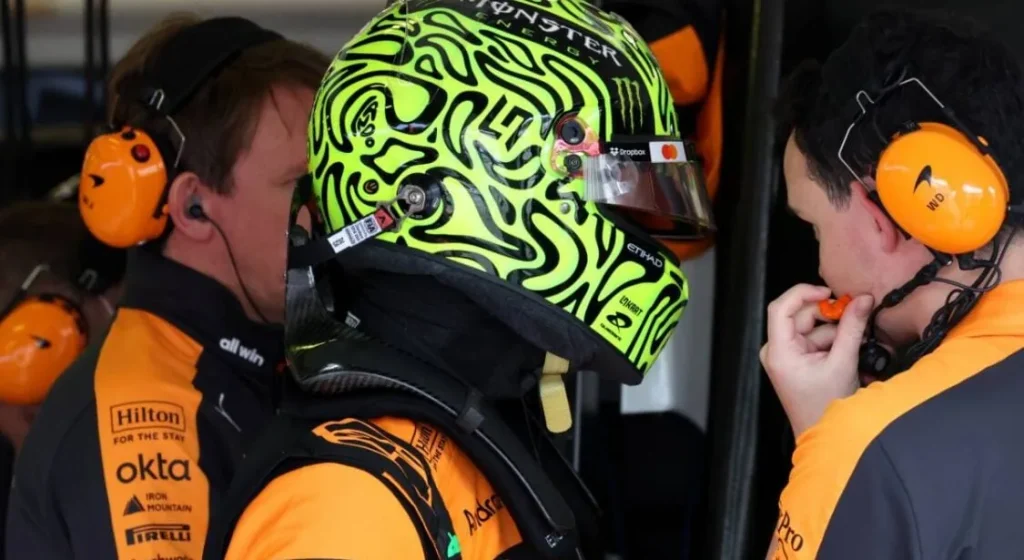
Norris very critical: “Probably the worst F1 cars”
Several drivers did not hide their frustration after the session. Among the most severe was Norris, only sixth on the grid with McLaren. According to him, the current power distribution – half thermal, half electrical – creates perverse effects.
“You have to slow down so much before the corners and lift off everywhere to make sure the battery is charged. If it’s too full, you’re also stuck. It’s very complicated.”
The Briton goes even further in his comparison with the previous generation: “We have gone from the best cars ever built in Formula 1 and the most enjoyable to drive to probably the worst.”
Same story from Hadjar, who admits he is not particularly enthusiastic about the new engine rules.
Russell more nuanced on chassis progress
Despite these criticisms, Russell adopts a more balanced analysis. The Mercedes driver believes that the cars also show improvements in certain aspects. According to him, the chassis behavior is more dynamic than before.
“The cars are more agile and move more. You can lock the wheels or lose the rear more easily. It feels more like a kart.”
He acknowledges, however, that energy management imposes a very different driving style: “Once you get used to it, it becomes a new normal. Is it pure racing? Probably not.”
The Briton finally recalls that the FIA is already working on adjustments and believes that Melbourne could be one of the most difficult circuits for this new generation of engines.
One thing is certain: after only one qualifying session, the 2026 single-seaters are already deeply dividing the Formula 1 paddock.
Read more 2026 F1 Driver Rankings