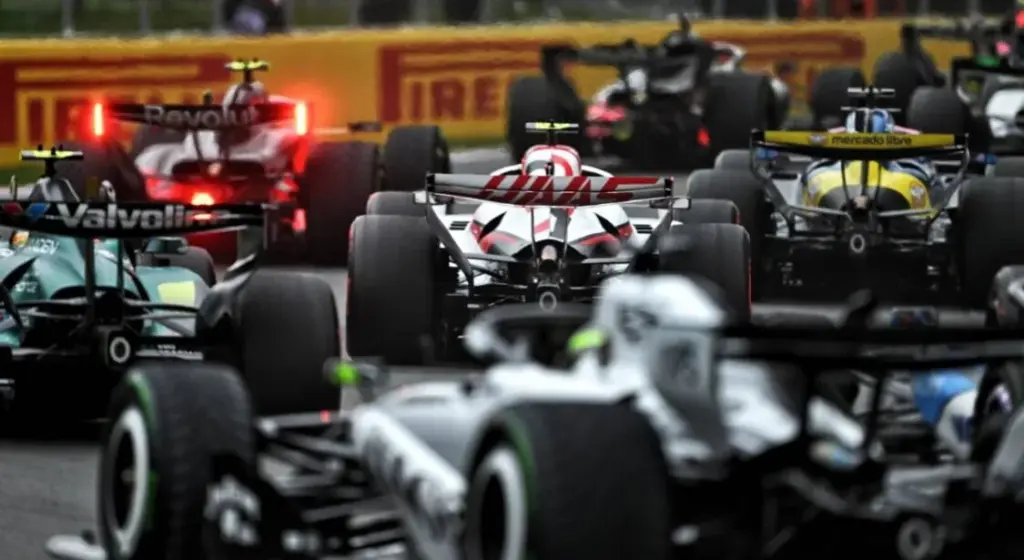
The 2027 engine modification project is far from being approved. Several manufacturers still oppose the proposed changes, to the point of jeopardizing the future of the new regulations.
Read more The future is not secured for Esteban Ocon at Haas despite denials in Canada
Presented as a solution to correct several flaws of the new Formula 1 cars, the future shift to a 60/40 engine power split might ultimately never come to fruition. F1, the FIA, and the engine manufacturers have been discussing a significant modification to the engine regulations planned for 2027 for several weeks, but negotiations remain extremely tense.
The initial idea was to reduce dependence on the electric part of the power units. The current regulation is based on a 50/50 power split between the internal combustion engine and the battery, a setup that causes several problems on track, notably the “super-clipping” phenomenon and significant phases of lift and coast.
To fix this, a shift to a 60/40 split was in principle accepted after the Miami Grand Prix. But this agreement remains very fragile today.
Audi and Ferrari are slowing the project
To officially validate such a modification, the FIA must obtain a supermajority within the Power Unit Advisory Committee. This body brings together the five engaged engine manufacturers: Audi, Honda, Ferrari, Mercedes HPP, and Red Bull Powertrains.
According to several reports from the paddock, Audi and Ferrari are currently opposed to the project, each for different reasons. Conversely, Mercedes and Red Bull support this evolution, while Honda remains more neutral.
James Vowles, director of the Williams team and a Mercedes customer, publicly acknowledged that several disagreements complicate the discussions.
“We all know that we are not yet where we would like to be with this regulation,” Vowles explained. “No one has left the negotiating table, but there are still many issues to resolve.”
Huge technical and financial constraints
According to Vowles, one of the main problems concerns the development deadlines imposed on manufacturers. Changing the regulation so late would force some engine manufacturers to revise a significant part of their already engaged technical projects.
“Some engine manufacturers cannot react as quickly as others,” he admitted.
“In the world of power units, some parts are ordered twelve to eighteen months in advance. Changing direction so quickly becomes extremely complicated.”
Read more Felix Rosenqvist (MSR) edges out David Malukas (Penske) in a thrilling sprint finish
The Williams boss also emphasizes the colossal cost of these engine programs, which make every modification particularly sensitive.
Chassis changes also necessary
The shift to a 60/40 split would also require several adaptations on the chassis side. The simplest solution would be to increase the fuel flow to give more power to the internal combustion engine.
But this modification would notably require larger fuel tanks, as the current cars were designed around the 50/50 concept.
“If you increase the fuel flow, then the size of the tank must also evolve,” Vowles reminded.
However, the Briton is reassuring regarding the overall impact on the cars.
“The FIA has been very firm on this subject and several compromises have already been found. Some teams will even be able to keep their chassis without being penalized.”
Verstappen continues to apply pressure
These tensions around the 2027 regulations come as Max Verstappen has been multiplying criticisms for several weeks. The Red Bull driver believes that the new F1 cars have become too complicated to operate, notably because of energy management.
The four-time world champion recently warned that continuing in this direction would be “mentally impossible” for him if no significant change is adopted.
The FIA and F1 will now have to find a compromise quickly, or risk seeing the 2027 project become one of the most explosive issues of recent years.
Read more Sixth in Montreal, Franco Colapinto finally says he truly feels comfortable at Alpine