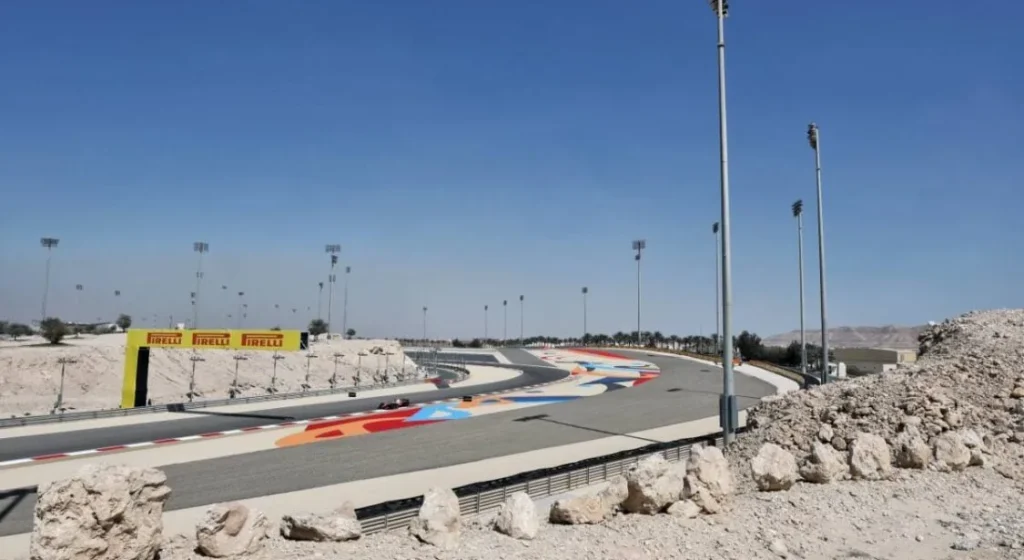
The 2026 calendar could see an unprecedented gap: the Bahrain and Saudi Arabian Grands Prix are threatened by escalating tensions in the Middle East.
Read more Isack Hadjar aims for the podium with Red Bull… but keeps his feet on the ground
Formula 1 could face an exceptional situation in the coming weeks. According to several paddock sources, the Grands Prix scheduled for April in Bahrain and Saudi Arabia are now seriously threatened.
This uncertainty stems directly from the recent military escalation in the Middle East. After strikes carried out by the United States and Israel, Iran retaliated by launching several missiles targeting various countries in the region.
Attacks notably targeted targets located in Dubai, Abu Dhabi, Oman, and Qatar. In Bahrain, a US military base housing the Fifth Fleet was hit, while energy facilities in Saudi Arabia were also targeted.
Several explosions were again reported on Thursday in Bahrain, fueling concerns regarding the holding of the two championship events.
Formula 1 is monitoring the situation closely
On the Formula 1 side, no hasty decisions have been made for now. Championship leaders are following the situation’s evolution with caution and are working closely with local and international authorities.
Officially, the sport claims to “monitor the situation closely” while studying different scenarios. But behind the scenes, pressure is mounting as a decision will need to be made quickly.
The main problem concerns the championship’s logistics. After the Chinese Grand Prix scheduled for next week, part of the teams’ equipment should normally already be on its way to Bahrain.
However, freight transport requires several administrative and customs procedures. Teams therefore need to know very quickly if the trip to the Middle East will indeed take place. A decision should ideally be made by the middle or end of next week.
Airspace still closed
The situation is all the more complex as the airspace of several Middle Eastern countries is currently closed or heavily restricted.
To host the F1 paddock, Manama International Airport would need to be declared safe for commercial and cargo flights. At present, security conditions do not yet allow for a guaranteed normal resumption of traffic.
Read more George Russell considered the favorite in the 2026 world title race
Even if hostilities were to cease in the coming days, many factors would still need to be analyzed before giving the green light to organize a Grand Prix.
Formula 1 has always maintained that the safety of its teams, personnel, and spectators remains the absolute priority.
A potential loss of earnings for F1
Beyond the sporting aspect, the cancellation of these two races would also represent a significant financial blow to the championship.
The promoters of the Bahrain and Saudi Arabian Grands Prix are among those who pay the highest hosting fees on the F1 calendar. Together, the two events represent at least 100 million dollars in hosting fees.
If the races were cancelled due to force majeure, these amounts would not be paid, which would create a notable loss of earnings for Formula 1.
Replacement circuits being considered
Faced with this scenario, several European circuits have already been mentioned as potential replacement solutions. Among the options studied are notably the Autodromo Enzo e Dino Ferrari in Imola, the Autódromo Internacional do Algarve, or Istanbul Park.
However, organizing an emergency race represents a major logistical and financial challenge for any promoter. The circuits would need to be capable of preparing the event in just a few weeks, while selling enough tickets to cover the organization costs and the fee requested by F1.
The situation recalls that of the 2020 season disrupted by the Covid-19 pandemic, when several circuits were added to the F1 calendar at the last minute.
The difference today is simple: Formula 1 has much less time to reorganize its calendar. If no quick solution emerges, the championship could therefore experience an unusual break between the Japanese Grand Prix at the end of March and the Miami Grand Prix in early May.
Read more Australia: the FIA reduces recoverable energy in qualifying