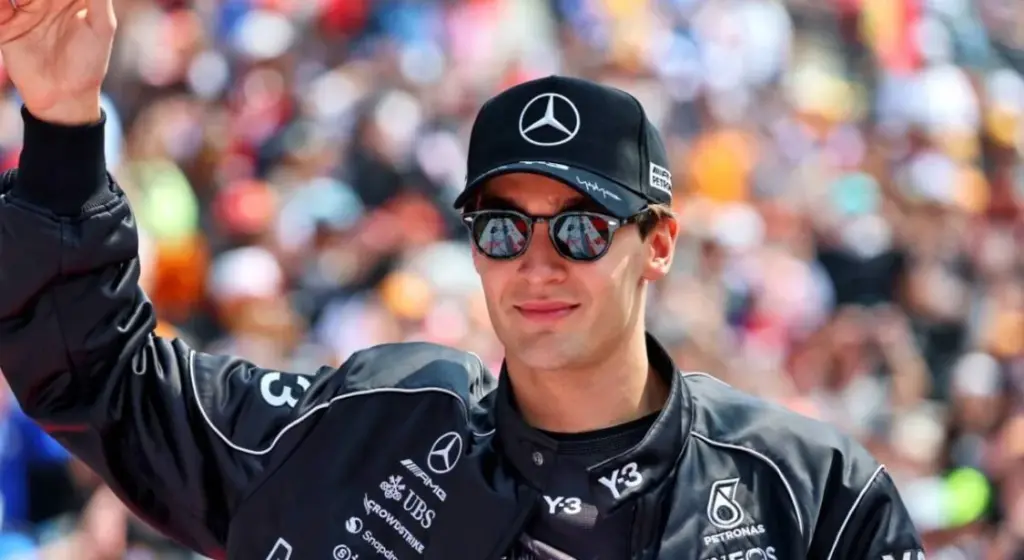
As discussions intensify on the new regulations, George Russell talks about a “closer collaboration than ever seen” between the F1 stakeholders.
Read more Max Verstappen sets the course at Red Bull after a frustrating start to the season
The unexpected April break offered a rare space for dialogue between the FIA, teams, and drivers. With no Grand Prix scheduled, exchanges multiplied to adjust certain sensitive points of the 2026 regulations, highlighted during the first races of the season.
Among the main topics: energy management in qualifying, with cars unable to run at full power on certain circuits, and the obligation to resort to techniques like “lift and coast” or “super-clipping”.
These phenomena were notably visible in fast corners like those in Melbourne or Suzuka, where cars suddenly lost performance due to energy constraints.
George Russell highlights strengthened cooperation
As GPDA director, George Russell plays a central role in these discussions. The Brit emphasizes a positive evolution in relations with the governing body.
“There are very constructive conversations with the FIA, and everyone is aligned on the goals” he explains, mentioning a climate of cooperation rarely reached in recent years.
One of the major objectives remains clear: to allow “full-throttle” qualifying without excessive energy management, and to limit too large speed gaps on track.
Safety and speed gaps at the center of debates
The accident between Oliver Bearman and Franco Colapinto in Japan served as a trigger to accelerate some reflections. Discussions focus notably on situations where speed differences become too large in unexpected track zones.
Russell explains that these gaps are often linked to opposing strategies: some drivers have surplus energy thanks to their boost systems, while others lack it at that precise moment.
This combination can create delicate situations, especially in areas not designed for this type of performance variation.
Read more Red Bull on the verge of implosion? The clear warning after the massive exodus
Towards targeted adjustments rather than a complete overhaul
Rather than completely overturning the rules, F1 stakeholders seem to favor precise adjustments. Russell talks about “simple solutions” that could have an immediate impact on car behavior.
Among the options discussed are limiting certain deployment powers or regulating boost modes in specific circuit zones.
“Small changes can greatly improve the overall feeling on track” he believes, convinced that these adjustments could reduce extreme energy management behaviors.
A smoother dialogue than before
Beyond technical aspects, Russell insists on the evolution of institutional relations. According to him, the FIA and drivers have never been so close in their exchanges.
“This is probably the most constructive relationship we have had in several years” he states, highlighting an important shift in the sport’s governance dynamics.
This closeness could facilitate the rapid adoption of certain measures, potentially as early as the next races, to correct the main problems identified at the start of the season.
An F1 in transition
Between technical innovations and regulatory adjustments, Formula 1 2026 is going through an intense adaptation phase. Current discussions show a common will to correct side effects without hindering technological progress.
While compromises seem inevitable, the goal is clear: preserve performance while making races more understandable, safer, and closer to the spirit of pure competition.
Read more Max Verstappen reacts to Lambiase’s departure and surprises with his support