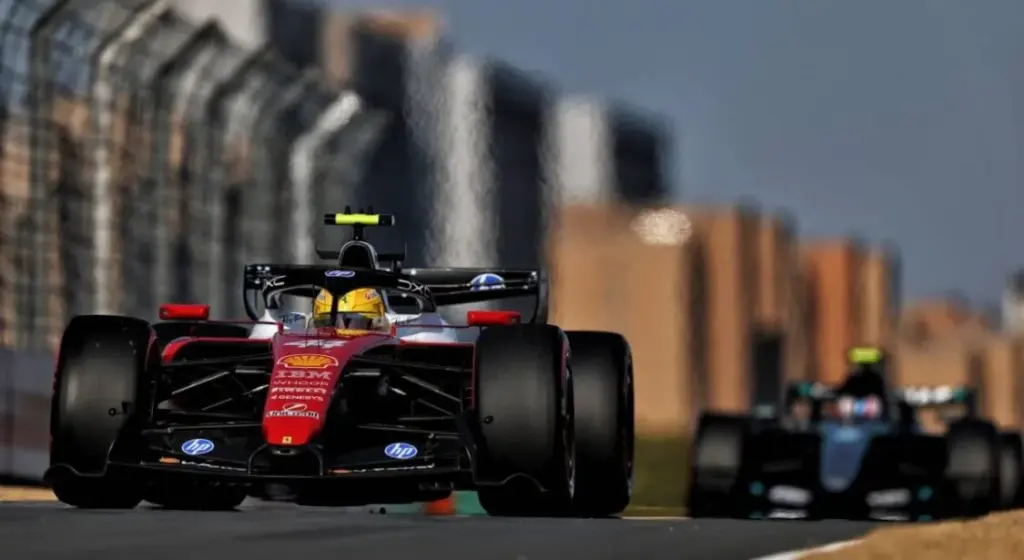
Criticized by many drivers, energy management on track does not shock Lewis Hamilton. The Briton mainly sees it as an evolution… not an aberration.
Read more Red Bull restructures its technical division: a setback for Waché?
Since the introduction of the 2026 rules, Formula 1 has profoundly changed the balance between the internal combustion engine and electric energy. Where the cars mostly relied on the combustion engine, the distribution is now much more balanced.
This change has direct consequences on driving. Drivers must now constantly optimize their energy management, notably through techniques like “lift and coast” or “super-clipping”.
These practices, increasingly visible on track, however, provoke many criticisms, some considering that they distort the very essence of the discipline.
Hamilton calls for perspective
In response to these reactions, Lewis Hamilton adopts a more measured position. For the seven-time world champion, these instructions are not absurd… simply different from what drivers knew before.
“I don’t find it strange, it’s just different” he explains. A way to put into perspective a debate that is sometimes exaggerated according to him.
Hamilton recalls that “lift and coast” is not new in itself. This technique was already used in the past, notably to save fuel or preserve tires. What changes today is the purpose of this practice. Now, it is no longer just about managing classic resources, but optimizing energy over the entire lap.
“Before, it was to save fuel or tires. Now, it’s to optimize energy over the lap” Hamilton specifies.
Read more Oliver Bearman lashes out at Colapinto after an «unacceptable» crash in Suzuka
This evolution requires a much more strategic approach to driving. Each circuit demands specific management, depending on its characteristics and the zones where energy can be recovered or deployed effectively.
Qualifying less “all out” than before
It is especially in qualifying that this transformation is felt. Traditionally, a flying lap had to be done at full power from start to finish, with a single goal: pushing the limits.
But in 2026, this logic is questioned: “On a qualifying lap, you normally want to be at full power until braking, but that’s no longer the case today” Hamilton acknowledges.
A reality that echoes the criticisms of some drivers, like Charles Leclerc, who regret a loss of spontaneity and boldness in the exercise. Despite the debates, Hamilton seems to consider this evolution as a natural step in the history of Formula 1. For him, drivers must above all adapt to these new constraints.
Rather than talking about a problem, the Briton speaks of a transformation of the profession, where management and race intelligence take even more importance.
It remains to be seen if this vision will be shared in the long term, as the FIA and teams continue to work on possible adjustments to improve the spectacle without compromising technological innovation.
Read more McLaren takes advantage of the forced break to aim higher in Miami