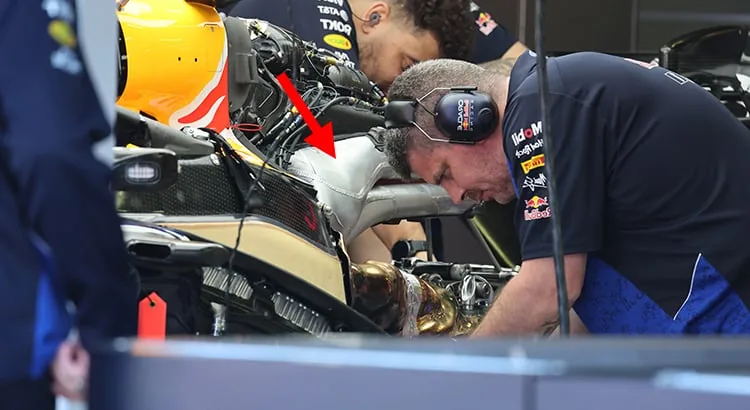
Exclusive images of the 2026 Red Bull engine reveal that the team has retained an intercooler architecture that has become rare in Formula 1.
Read more Haas well-positioned to be «best of the rest»: Esteban Ocon in the top 10
Images of the 2026 Red Bull engine, visible below and captured while the bodywork was removed, show a surprising technical choice. While the majority of teams have been using water-to-air exchangers since 2022, Red Bull has decided to retain an air-to-air intercooler.
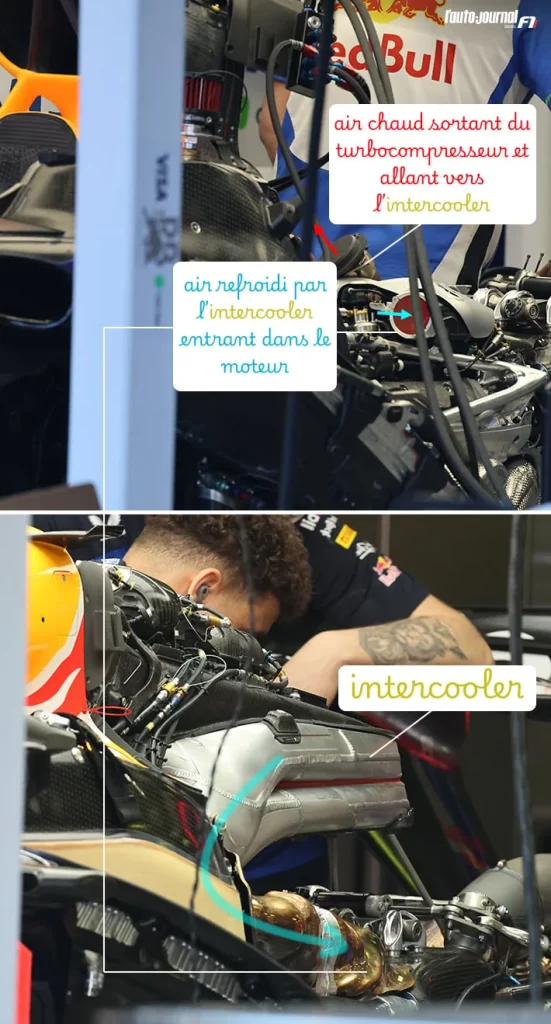
Turbocharged engines require a lot of cooling, a key area in F1. Air enters the turbo via the intake located in the roll hoop and passes through the air filter. When compressed, its temperature increases significantly. It must then be cooled to improve its density, as denser air contains more oxygen, promoting combustion efficiency.
This is the role of the intercooler, a heat exchanger in which hot air passes through tubes where it is cooled either by outside air (air-to-air) or by a water circuit (water-to-air).
A solution that has become rare
Since 2022, regulations have allowed water-to-air exchangers to be manufactured using 3D printing, improving their efficiency while reducing weight and bulk. Almost all teams have adopted this solution, with Red Bull remaining the exception with its Honda engine.
In 2026, Red Bull is producing its own power unit with the help of Ford, while Honda supplies Aston Martin. Despite this change, Red Bull has retained the air-to-air architecture, as clearly shown by our exclusive images under the hood of the RB22 of Max verstappen and Isack Hadjar and the VCARB03 of the Lawson-Lindblad duo.
Read more Lewis Hamilton sees positives at Ferrari despite a «tricky» Friday in Melbourne
The new 2026 rules for the F1 engine introduce a distribution close to 50 % between hybrid and thermal power, changing cooling requirements. Hybrid systems require more cooling, while the engine and turbo require less.
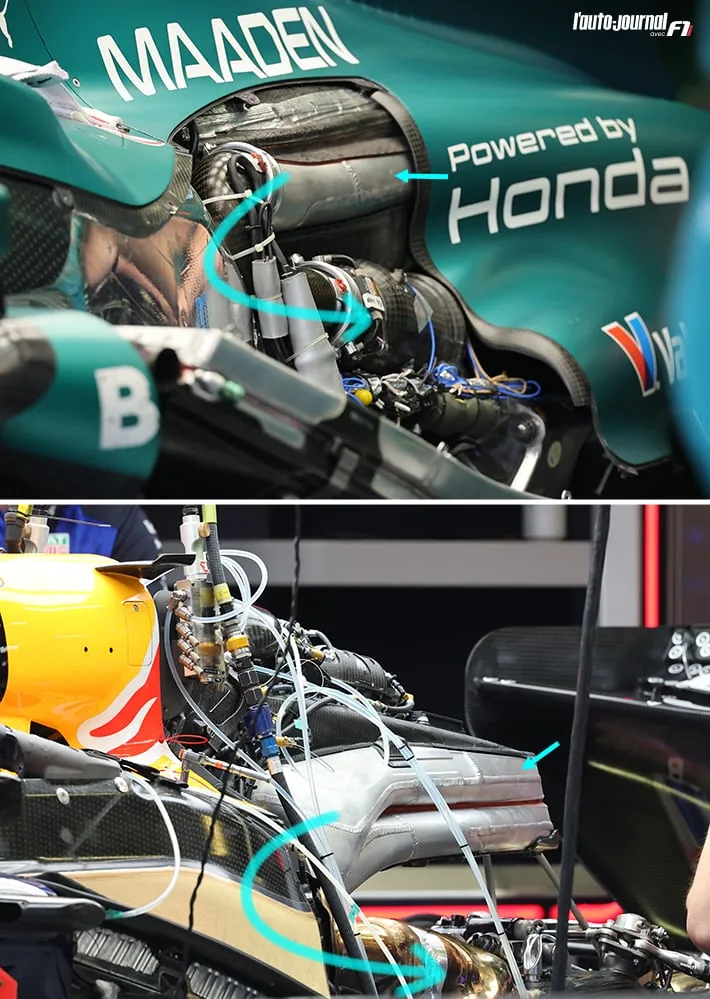
Red Bull has therefore redesigned the layout of the exchangers. On previous generations, the air-to-air intercooler was divided into two elements placed in the sidepods, a configuration difficult to integrate with the very compact sidepods of 2026. The solution adopted: a single intercooler above the engine and hybrid cooling moved to the sidepods. The air path becomes very short, reducing turbo lag before reaching the intake ducts.
Aston Martin adopts a similar architecture
Images of the Honda-powered Aston Martin show a similar configuration: an air-to-air intercooler above the engine, with similar routing between the turbo and the intake ducts. Some detail differences exist, but the logic remains comparable.
This similarity is not surprising: many personnel transfers have taken place between the two programs, including that of technical director Adrian Newey.
The intercooler configuration is not included in the power unit homologation, which allows teams to modify this architecture for subsequent seasons.
Read more F1 penalty points: the FIA relaxes sanctions… but also provides for direct exclusions