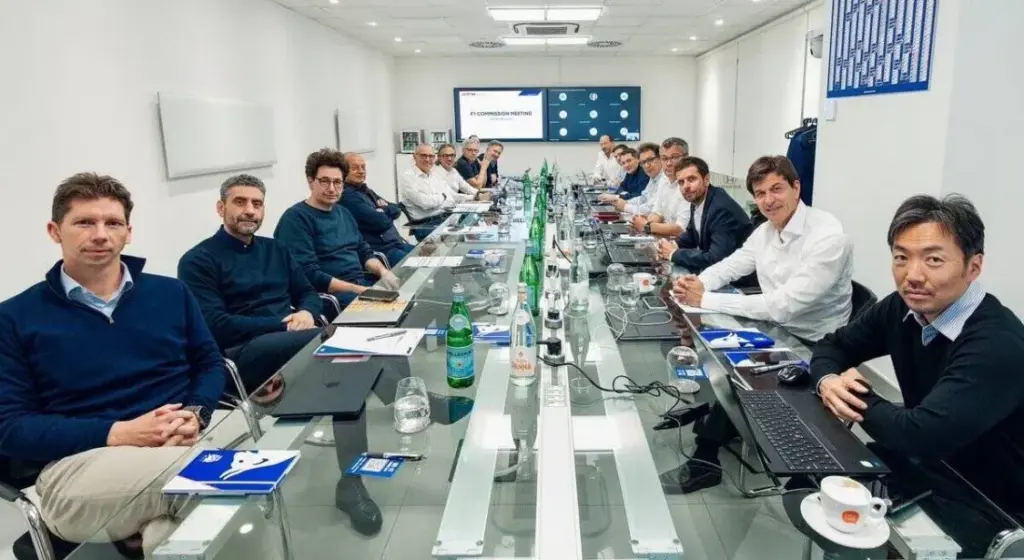
Discussions on the future of Formula 1 engines, regarding the distribution between electric and thermal power, remain at a standstill after the F1 Commission meeting held on Tuesday.
Read more Norris and Leclerc summoned by stewards after unusual rule breach in Monaco
While several stakeholders hoped to progress towards an agreement concerning an evolution of engine regulations from 2027, no consensus could be found.
The debate focuses on a modification of the balance between the power delivered by the internal combustion engine and that coming from the electric part of the power units introduced in 2026.
The idea would be to slightly strengthen the role of the internal combustion engine to reduce dependence on electrical energy, a direction supported by several drivers and teams who consider the new cars too constrained by energy management.
A qualified majority still out of reach
However, manufacturers remain deeply divided on the subject. Several technical solutions are currently being studied, particularly around fuel flow rules, but each scenario has different implications in terms of performance, costs, and reliability.
Some engine manufacturers fear that a modification of the rules would necessitate developing new components, even though significant investments have already been made to prepare for the arrival of the 2026 regulations. Others, on the contrary, believe that an adjustment is necessary to improve the spectacle and the driving characteristics of the cars.
The situation is all the more complex as any significant modification to the regulations requires the approval of a supermajority of engine manufacturers, as well as the support of the FIA and Formula One Management. However, the interests of the different manufacturers still diverge widely, which currently prevents any decisive progress. Despite several weeks of discussions and signs of openness from both sides, no compromise emerged during this meeting.
Read more Charles Leclerc shares the same ambition as Fred Vasseur for Ferrari: in total harmony
Decisions taken on other subjects
In parallel, the F1 Commission nevertheless validated several regulatory adjustments. Teams will notably have an additional day of winter testing from next season, bringing the total to four days of pre-season tests.
The venue has not yet been officially confirmed, although Bahrain remains the most likely candidate. Minor modifications concerning aerodynamics and certain bodywork elements have also been approved.
The FIA has also strengthened the rules governing testing with older single-seaters, the famous Testing of Previous Cars (TPC). Teams will no longer be able to use these sessions on circuits that will soon host a Grand Prix, to avoid any indirect advantage in terms of preparation. The objective is to refocus these tests on driver development and the internal programs of the teams.
Other measures under consideration
Other measures aimed at limiting costs also continue to be studied, including a possible reduction in certain race distances or a limitation of reconnaissance laps before the start. But despite these advances on secondary subjects, the fundamental question of the future of engines remains open.
While several influential paddock figures, such as Max Verstappen, Carlos Sainz, and Stefano Domenicali, have spoken out in favor of a revision of the current engine concept, manufacturers have still not found common ground.
At this stage, no decision is expected in the short term, and the debate on 2027 engines is expected to continue to fuel the political and strategic discussions currently traversing Formula 1.
Read more An AI big name joins Williams