Seeing F1 cars roar around the Arc de Triomphe would make many enthusiasts dream, but turning the streets of Paris into a race track represents a considerable logistical, political, and financial challenge.
Read more Max Verstappen challenges the engine advantage given to Red Bull: «These are two different things»
The day after the first Spanish Grand Prix held in Madrid, the idea of seeing a French Grand Prix return to the world calendar on an original track in the capital resurfaces.
It was recently brought up again by Esteban Ocon: the French driver dreams of a Grand Prix around the Arc de Triomphe and reminds that Paris has already hosted Formula E on the Esplanade des Invalides between 2016 and 2019, on a track shortened to less than 2 kilometers.
A particularly high cost
But organizing an F1 race would be on a completely different scale than the electric competition. Unlike the Tour de France, which only temporarily occupies the streets, a Grand Prix would require closing several major roads for several days. It would also be necessary to install safety barriers, modify the road surface, create the necessary infrastructure for the teams, and accommodate tens of thousands of spectators.
The financial aspect is another major obstacle. Creating an urban circuit meeting Formula 1 standards requires considerable investments, to which are added the rights to organize a Grand Prix, an economic model impossible without government support.
It would therefore be necessary to convince public authorities as well as various partners to finance and support an event particularly complex to organize in the heart of a city as dense as Paris. The scandals still echo since the failure of the F1 return to Le Castellet at the beginning of the decade, an experience that created a huge public debt for the region and local communities that helped finance the event.
Read more Andrea Stella amazed by Norris after Madrid: «One of the most impressive laps I’ve ever seen»
A politically difficult project
The environmental issue could also weigh heavily. For several years, Paris has been trying to reduce the place of cars and promote soft mobility. In this context, organizing an international car race right in the city center could be difficult to defend politically.
However, the project is not totally impossible. The precedent of FE shows that a car race can be organized in the streets of the capital. Esteban Ocon remains optimistic: “Nothing is impossible. It’s just a matter of political will, as Madrid has just demonstrated.”
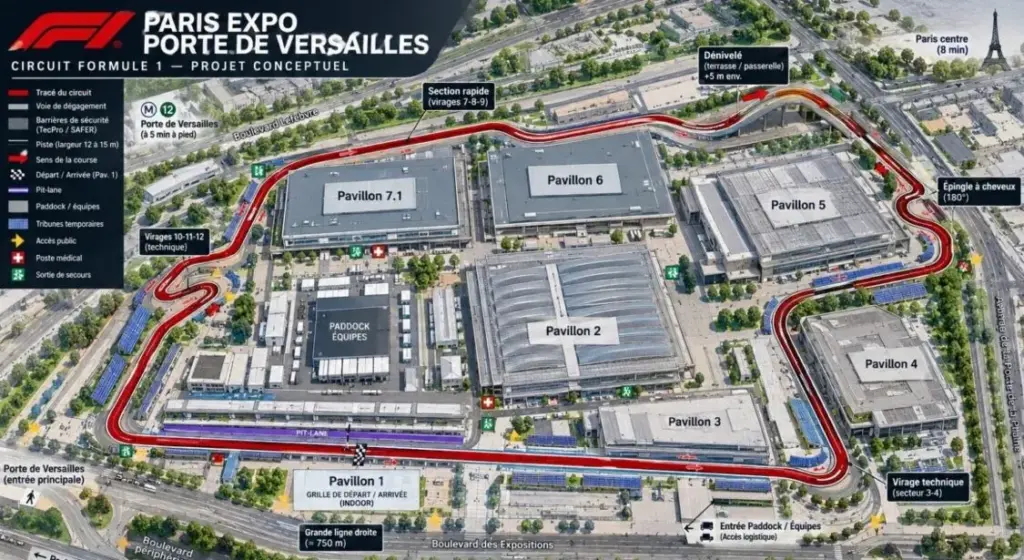
By looking for a site more suitable than Place de l’Etoile, the alternative of the Parc des Expositions de la Porte de Versailles appears more credible (map above) given the existing infrastructure and accessibility via public transport, somewhat like around the IFEMA complex in Madrid. When mentioning a possible return of France to the calendar, Formula 1 CEO Stefano Domenicali also encouraged this approach.
In practice, the main obstacles are therefore financial, logistical, and political. Despite the spectacular image of single-seaters passing in front of the Arc de Triomphe, dear to Michel Vaillant’s author Jean Graton who imagined an album titled “At 300 km/h in Paris”, a Formula 1 Grand Prix in the City of Light remains for now more a dream than a real project.
Read more Lewis Hamilton reveals where Mercedes’ huge advantage lies