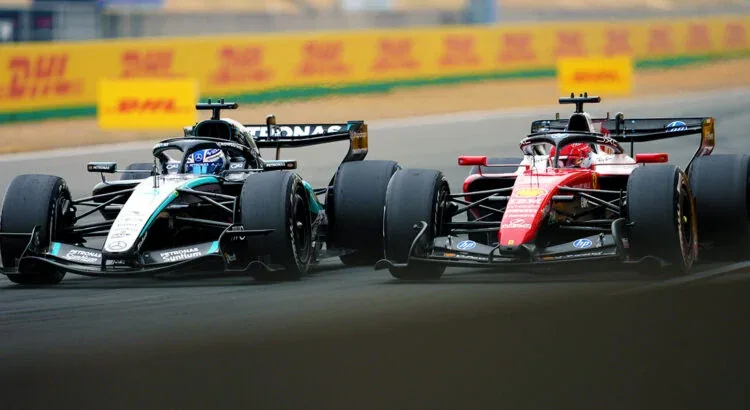
With the success of Andrea Kimi Antonelli in Spain, Mercedes finally joins Ferrari at the top of a staggering statistical record in Formula 1. A perfect tie on the surface, but one that hides two diametrically opposed philosophies and eras.
Read more Red Bull admits a “serious” problem that causes Verstappen to lose a lot of time
Andrea Kimi Antonelli’s victory in Madrid will not only remain as the eighth of his career. It also allowed Mercedes to reach 251 wins as an engine manufacturer in Formula 1, exactly as many as Ferrari.
A historic tie, all the more remarkable because the two manufacturers have followed very different paths.
A gap that seemed impossible to close
Ferrari has been accompanying Formula 1 practically since its inception and has never left the World Championship. Mercedes, present in 1954 and 1955, on the other hand withdrew from competition before returning to F1 as an engine manufacturer in the 1990s.
The gap was still huge at the beginning of the century. At the end of the 2004 season, Ferrari had 182 wins as an engine manufacturer, compared to only 43 for Mercedes.
Twenty-two years later, Mercedes has made up this 139-win deficit.
But this tie at 251 hides an essential difference: Ferrari won almost all its races with its own team, while Mercedes owes a considerable part of its total to its partners.
McLaren played a huge role
Of the 251 successes achieved by a Maranello engine, 250 were by Scuderia Ferrari. The only exception remains Sebastian Vettel’s victory at Monza in 2008 with Toro Rosso.
At Mercedes, the record is much more shared.
The official team has won 141 Grands Prix, but McLaren added 101 with a Mercedes engine. Brawn GP contributed eight wins in 2009, while Racing Point brought the last one with Sergio Pérez at Sakhir in 2020.
In other words, 110 of Mercedes’ 251 wins were achieved by other teams.
That’s nearly 44% of the total.
The hybrid era changed everything
Mercedes’ spectacular catch-up is obviously largely explained by its dominance after the introduction of hybrid engines in 2014.
Read more Racing Bulls keeps Nikola Tsolov in its plans for 2027, Liam Lawson in uncertainty
At the end of the 2013 season, the German manufacturer had only 99 wins, compared to 222 for Ferrari.
Mercedes has therefore won 152 more since 2014.
The 2014-2021 period was particularly prolific: Mercedes accumulated successes with its official team, winning eight consecutive constructors’ titles, while its engines also equipped several other teams.
Even when the Silver Arrows lost their dominance with the arrival of the 2022 regulations, the counter kept ticking.
Mercedes won only one race in 2022, none in 2023, then three in 2024. But McLaren’s return to the forefront then accelerated the movement: the Woking cars largely contributed to the 16 Mercedes wins recorded in 2025.
And in 2026, the official team’s recovery completed the job.
Ferrari can now be overtaken
Antonelli’s success thus brings both engine manufacturers to 251 wins each.
Behind them, the gap is immense. Ford, whose total mainly consists of successes achieved with the legendary Cosworth DFV, remains at 176 wins. Alfa Romeo follows far behind with 12.
Mercedes could especially take the lead of this ranking alone with its next victory.
What seemed almost inconceivable at the beginning of the 2000s is therefore now within reach of a single Grand Prix: for the first time in the history of the World Championship, Ferrari could no longer be the most successful engine manufacturer in Formula 1.
And the irony of the story is that Mercedes needed much less time than its Italian rival to reach 251 wins.
Read more Ferrari foresees an engine penalty for Charles Leclerc in Baku for not giving up