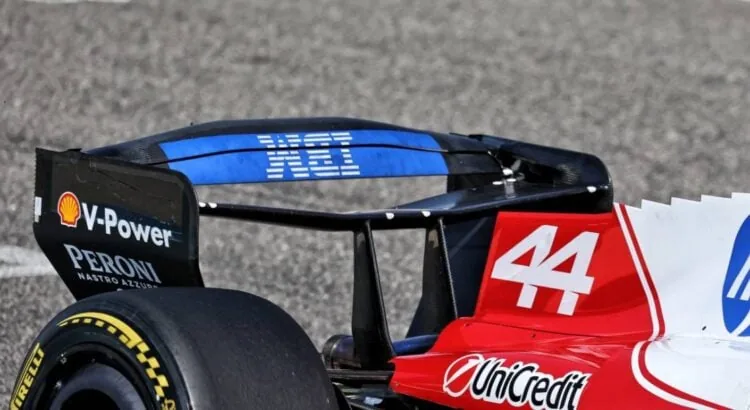
The Chinese Grand Prix could mark a turning point for Ferrari, determined to close the gap with Mercedes at the start of the 2026 Formula 1 season thanks to a lethal weapon: its pivoting wing!
Read more Towards an F1 calendar earthquake? Bahrain and Saudi Arabian Grands Prix under threat
The round held at the Shanghai International Circuit could notably confirm – or nuance – the advantage shown by Mercedes against Ferrari during the opening weekend.
In Melbourne, the gap observed in qualifying was particularly striking. George Russell’s W17, the pole position holder, had outpaced Charles Leclerc’s SF-26 – only fourth on the grid – by about eight-tenths of a second.
A gap to close
Ferrari had, however, explained that this difference was partly due to difficulties encountered in Q2 and Q3, particularly in the energy management of the power unit.
In the race, the gap appeared less clear, as the different strategies adopted by the two teams blurred the performance reading. Despite this, the advantage seems to remain on Mercedes’ side for now. Ferrari team principal Frédéric Vasseur confirmed after Melbourne that aerodynamic updates would be introduced as early as China on the SF-26.
This announcement immediately fueled speculation in the paddock. Several sources mention the possible arrival of a very specific rear wing already seen during the Bahrain winter tests and nicknamed “Macarena” by some engineers. This device is distinguished by a rotating flap capable of reaching approximately 270 degrees. During the Bahrain tests, Lewis Hamilton’s Ferrari briefly used this concept for a few laps.
Read more Aston Martin on the brink of crisis in China: Honda admits it cannot fix the problem before Suzuka
A significant potential gain in Shanghai
The main interest of this wing lies in the significant reduction of aerodynamic drag on the straight. Combined with the lift generated by the car’s general configuration, this system can cause a more pronounced stall of the diffuser, which improves top speed.
Measurements taken during testing reportedly showed a top speed gain of between 5 and 8 km/h at the end of the straight compared to a classic mobile rear wing. Such an advantage could be particularly useful in Shanghai, where the long back straight – about 1.2 km leading to Turn 14 – is one of the most important overtaking zones on the calendar.
Urgent developments
According to the Italian press, several new parts destined for China were prepared in extremely short timeframes at Maranello. Some were reportedly even transported to China as carry-on luggage by engineers to meet the very tight schedule of the sprint weekend.
Ferrari therefore seems determined to mobilize all its resources to improve the performance of the SF-26 from this second round of the season. The goal is clear: to prevent Mercedes from widening the gap at the start of the championship and to maintain pressure on the team led by Toto Wolff.
If this rear wing works as expected, it could also help Ferrari partially offset the advantage Mercedes currently holds in the energy management of its power unit – an area that already seems crucial in the technical era inaugurated in 2026.
Read more A Chinese giant ready to land in F1? BYD is seriously studying an entry into the sport