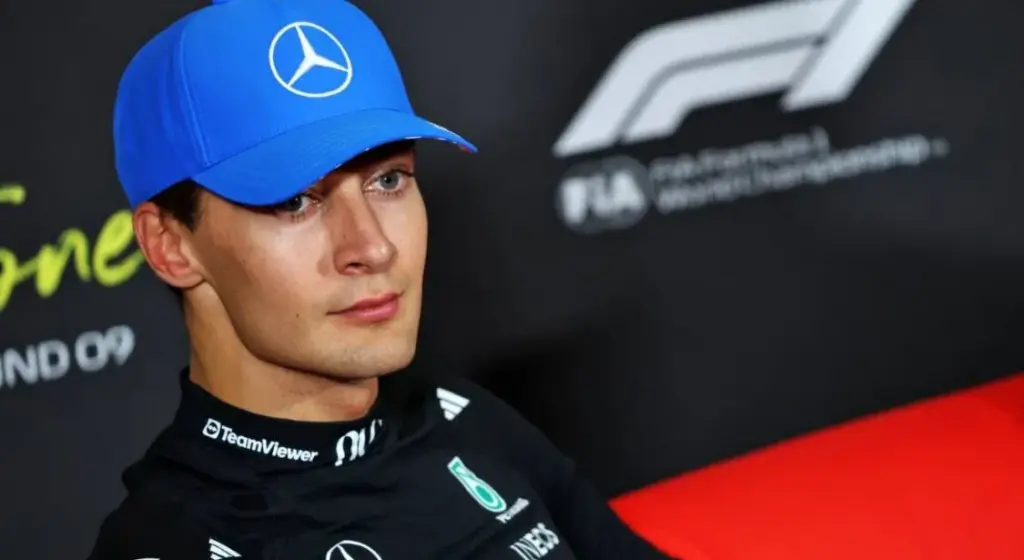
Carlos Sainz wants to penalize drivers causing yellow or red flags in qualifying. George Russell acknowledges the advantages of this idea but also points out its limitations.
Read more Fred Vasseur downplays the role of a «miracle trigger» in Lewis Hamilton’s return to form at Ferrari
The management of incidents in qualifying continues to be debated in Formula 1. Following Carlos Sainz’s proposal to impose a grid penalty on drivers responsible for a yellow or red flag, George Russell shared his analysis of a measure that could profoundly change the approach to timed sessions.
The Mercedes driver believes this idea deserves to be studied but reminds that it could also have significant consequences on how drivers approach their fast laps.
A proposal born from several controversial situations
The reflection around this rule is not new in the paddock. It was notably revived after several episodes where a driver causing an incident indirectly influenced the qualifying results by disrupting their rivals’ attempts.
The most recent case concerns the Austrian Grand Prix qualifying. George Russell had secured pole position under particular circumstances after Max Verstappen’s accident.
Kimi Antonelli had interrupted his fast lap thinking he was facing a double yellow flag, a situation that forces drivers to significantly reduce their speed and be ready to stop. Meanwhile, Russell had continued his effort under a single yellow flag, which allowed him to keep his best time.
At Silverstone, Carlos Sainz, in his capacity as GPDA director, then proposed a system where any driver causing a yellow or red flag would automatically receive a grid penalty.
Russell sees arguments on both sides
Asked about this proposal, George Russell acknowledged that it could provide an answer to some frustrating situations for drivers.
“This has definitely been discussed before: if someone causes a yellow or red flag, they should be penalized.”
The Brit highlights that an on-track incident can have significant consequences for other competitors, especially when a fast lap is canceled or compromised by a neutralization.
“Because it impacts other drivers, whether your best lap is deleted or not, and we see this in other categories.”
However, Russell also believes that such a rule could push drivers to take fewer risks, while qualifying is precisely a moment when limits should be pushed.
“But on the other hand, some would also say that drivers would no longer take as many risks in qualifying, and you want to see drivers push the limits.”
Read more The Verstappen clan calms things down: his manager clarifies his future at Red Bull
For him, the balance between spectacle and sporting fairness is particularly difficult to find.
The dilemma of yellow flags in qualifying
Russell recalls that the question had already arisen after the Azerbaijan Grand Prix, where several drivers went straight into the run-off areas after locking their wheels.
At the time, some competitors felt that a single yellow flag was sufficient in these situations, while a double yellow flag could unfairly penalize drivers attempting their last lap.
“That was the general rule adopted: when there is an incident in qualifying, a single yellow flag is usually shown.”
But the Mercedes driver insists on a major difficulty: the initial decision lies with the track marshals, who must react extremely quickly.
“We must also remember that the person waving a yellow flag is a volunteer, the marshal. It is not the FIA at first. The FIA then analyzes the situation and can change the decision if deemed necessary.”
According to him, expecting a perfect reaction within just a few seconds is almost impossible.
“The incident in Austria should have been a double yellow flag”
George Russell nevertheless believes that some cases are clearer than others. According to him, the incident involving Max Verstappen in Austria should have resulted in a double yellow flag.
“So, should the incident in Austria have been a double yellow flag? Of course, yes.”
But he also reminds that decisions are never easy to make in the heat of the moment.
“There have been many situations in the past where drivers said it shouldn’t have been a double yellow flag, but a single yellow flag was enough. So it’s not an easy job.”
For Russell, Carlos Sainz’s proposal therefore raises a real fundamental question: how to protect fairness in qualifying without preventing drivers from continuing to attack at the limit? A delicate balance that the FIA will probably have to examine again in the coming months.
Read more A Verstappen loyalist finds several familiar faces at Williams