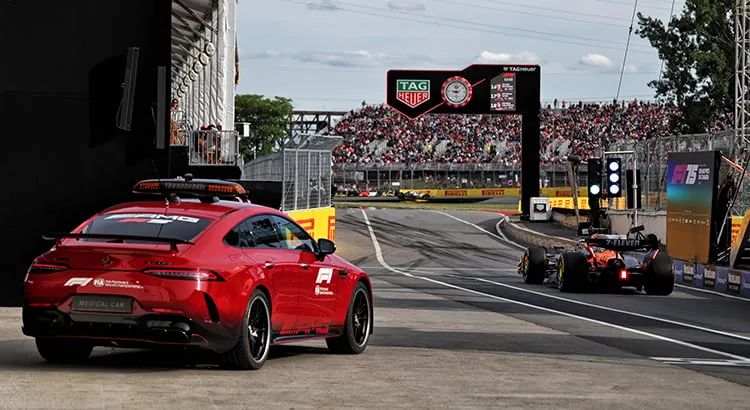
The Canadian GP could expose the limits of the 2026 F1 cars. Between reduced energy recovery and cool temperatures in Montreal, teams are expecting a particularly tricky weekend.
Read more David Coulthard makes a strong prediction about Max Verstappen’s future at Red Bull
After several already challenging weekends this season, the Canadian Grand Prix should push the new 2026 cars to their limits. The reason? The Montreal track imposes one of the lowest energy recovery limits on the calendar.
In qualifying, teams will only have 6 MJ of recharge per lap, compared to 8 MJ initially planned during the regulation design. Only Monza will be even lower with a limit set at 5 MJ.
This constraint is directly linked to the difficulty of recovering enough energy on certain circuits. The FIA deliberately lowered the caps to prevent drivers from having to adopt excessive energy-saving strategies during their fast laps.
But this reduction creates another problem: if a driver reaches the allowed recovery cap too early, they can no longer recharge their battery until the finish line. As a result, they risk running out of electric energy in the last sectors of the lap.
An asymmetrical circuit that complicates everything
The Canadian challenge does not only come from the low energy cap. The very profile of the Circuit Gilles Villeneuve, which ranks 13th among recharge possibilities, makes energy management particularly complex.
The first half of the lap includes several heavy braking zones and short accelerations, which naturally favors energy recovery. On the other hand, the second part of the circuit — notably the hairpin, the exit towards the long straight, and the last chicane — requires a lot of electric deployment while offering few recharge opportunities.
This asymmetry will force drivers to manage their battery with extreme precision. Recovering too much at the start of the lap could prevent recharging later, while too aggressive use of energy could leave the car without electric assistance during long acceleration phases.
The problem had already been observed in Miami this year, where some drivers struggled to keep the turbo and battery in their ideal window before launching their fast lap.
Albon: “Montreal will be exactly the same”
Driver Alexander Albon had already highlighted the difficulties encountered in Miami and believes Montreal will reproduce exactly the same scenario.
Read more Canadian GP: Weather threatens to disrupt the F1 weekend
“Montreal is exactly the same: a long straight to the last corner, then you immediately go again. It was easier in China, Melbourne, or Japan.”
“When you have a long straight followed by heavy braking, it is very easy to recover energy. You almost have to be careful in this braking zone.”
Teams will also have to closely monitor turbo management, as long full-throttle phases further complicate the synchronization between energy recovery and electric deployment.
The cold in Canada could further worsen the situation
In addition to these energy difficulties, there is another classic headache of the Canadian Grand Prix: tire warm-up.
The Circuit Gilles Villeneuve is known to be one of the most difficult tracks on the calendar to properly heat the tires, notably because of the long straights that strongly cool the rubber.
The temperatures expected this weekend could worsen the situation. Forecasts predict lows near 5°C on Friday morning, with only about 15°C expected at sprint qualifying time.
Drivers could thus be forced to do more preparation laps before their timed attempts, which would further increase the pressure on energy management.
Even though Pirelli has chosen the softest compounds available for this weekend, the tires remain slightly harder than those used last year, since the C6 is no longer part of the 2026 range.
Teams particularly fear the appearance of graining in Canada, even though Pirelli believes this phenomenon has been reduced thanks to the new tires introduced with the 2026 regulations.
Read more Verstappen praised for his risk-taking: «No one else would have dared»