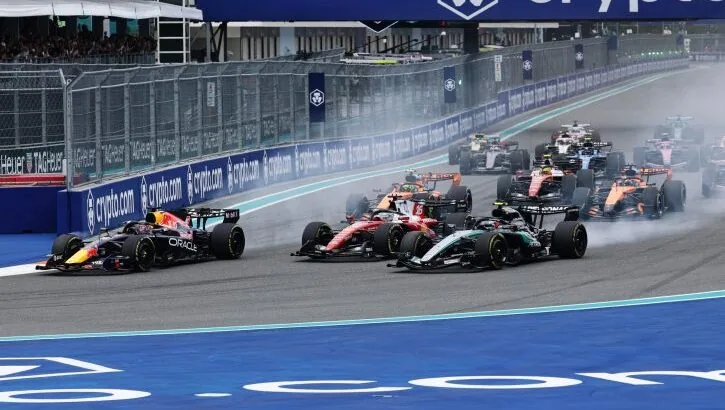
Formula 1 has set up shop in North America this May: after Miami, the next Grand Prix will take place in Montreal this weekend and the popularity of the sport is growing there.
The American revolution of Formula 1 is no longer considered just a passing trend.
At Apple, the development of the championship in the United States is increasingly seen as a story of very long-term growth, with a potential still largely untapped.
More female audience than the NFL
As F1 continues its aggressive expansion in the American market, Apple’s senior vice president of services, Eddy Cue, believes the sport is only scratching the surface of what it can become in the American sports landscape.
And above all, Apple is not looking to immediately compare F1 to the giant that is the National Football League. For Cue, the goal is not to compete directly with the NFL in the short term, but to gradually build a lasting cultural presence.
“We are not focused on the NFL,” he explains. “There is also the NHL, the MLB, and many other sports that already occupy the top. I mainly see a huge growth margin.”
Cue notably highlights the evolution of the F1 audience in the United States. According to him, the championship now attracts a much younger audience than most traditional American sports, with a strong increase in the female audience: “The young and female audience is growing tremendously on Apple. I don’t know how many millions that represents in the long run, but the growth can be exponential.”
Rising audience
Recent figures reinforce this confidence. In 2025, ESPN was already recording an average of about 1.3 million viewers per Grand Prix during the last year of its current contract with F1. And the first indicators related to Apple’s involvement suggest further growth.
Read more The GEN4 on display in Monaco: the electric revolution is underway!
But beyond the audiences, Apple believes that Formula 1 is mainly starting to gradually enter American popular culture. Streaming, social networks, celebrity presence, and Hollywood projects are helping to transform the image of a sport once considered marginal in the United States.
Cue explains that this evolution became very clear during screenings related to the upcoming Hollywood film about F1 produced with Apple: “ Before the film, when we asked people how many had already watched an F1 race, no one raised their hand. After the film, when we asked if they would like to attend a race, everyone raised their hand.”
According to Cue, the potential far exceeds a simple 10 or 20% increase: “The real question is: how many times can we still multiply this growth in the years to come?”
Integrating culture
F1 CEO, Stefano Domenicali, fully shares this vision. For him, the real goal is no longer simply to organize a few spectacular Grands Prix in the United States, but to make F1 part of the daily life of Americans.
“To be really strong in the United States, you have to be part of their culture,” he explains. “Be in their daily life. Be relevant in all the areas where Formula 1 can have a place: technology, sports, entertainment…”
Domenicali considers Apple precisely as the ideal partner to achieve this goal thanks to its immense technological and media ecosystem: “When people talk about Apple, we want them to also talk about Formula 1.”
The modern American strategy of F1 therefore relies less on the idea of directly competing with the NFL than on becoming progressively impossible to ignore. With the Miami, Austin, and Las Vegas Grands Prix, the discipline has already significantly strengthened its presence. But for Domenicali, the real challenge lies elsewhere: to enter durably into the consumption habits of Americans.
Read more Max Verstappen reacts with philosophy after the immense disappointment at the Nürburgring