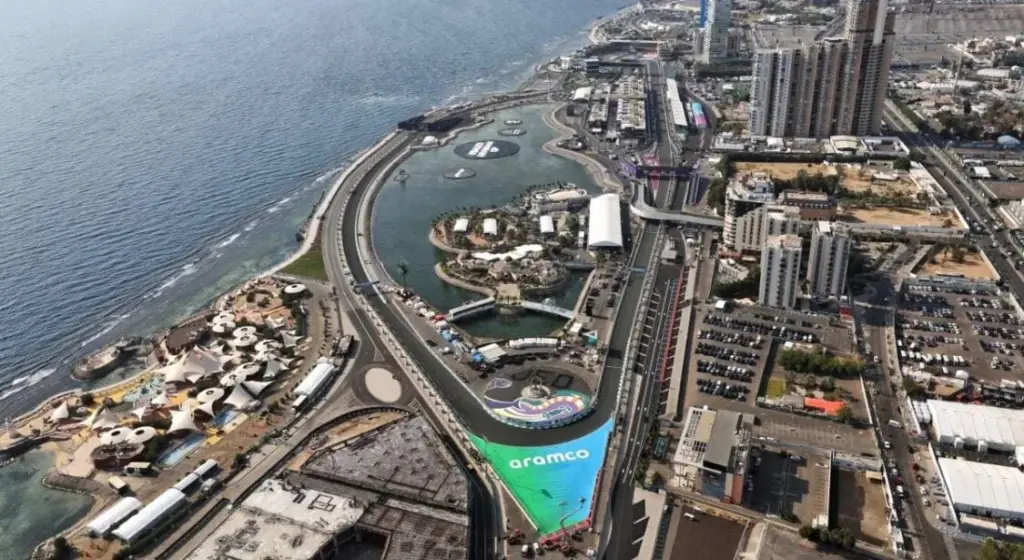
The postponement of the Bahrain and Saudi Arabia Grand Prix races has plunged Formula 1 into a major logistical and political headache, with no guarantee of saving the situation as long as the war continues.
Read more Mercedes, Ferrari, Red Bull, Audi, Honda: who has the best engine in F1 2026?
Due to the conflict in the Middle East, the two races could not be held as planned, and the championship leaders are now looking for a solution to save at least part of the calendar without causing total chaos in the season.
The revenues guaranteed by the organizers of these two Gulf rounds amount to nearly 100 million dollars, income that F1 would prefer not to have to do without.
Postpone the end of the season?
The head of Liberty Media, Derek Chang, confirmed that F1 absolutely wants to reschedule at least one of the two events: “We will act cautiously and continue to evaluate the calendar this year. It might be possible to reschedule a race towards the end of the season.”
The most realistic solution would be to insert an additional race between the Baku and Singapore Grand Prix in September. This scenario would limit calendar disruptions but would create an extremely intense series of triple-headers, that is, three consecutive race weekends several times during the season.
Rescheduling both races, however, seems much more complicated. From the end of October, F1 traditionally switches to its American tour, leaving very little room to add extra rounds in November. Postponing a race until December would also imply changing the position of the Abu Dhabi Grand Prix, which is contractually supposed to remain the championship finale.
Logistical nightmare
The CEO of F1, Stefano Domenicali, assures that several backup scenarios are under study, including spontaneous bids from Portugal and Turkey, to avoid a significant reduction in the number of races: “We obviously have plans. The reaction time is not the same whether it is about recovering a race canceled in April or a potential problem at the end of November or early December.”
Read more Lando Norris demands a bigger role for drivers: “We are sometimes sidelined”
Beyond the calendar, the conflict also causes significant logistical difficulties. Part of the teams’ equipment remains stuck in Bahrain, complicating the organization of transport to the upcoming Asian rounds. Singapore appears notably as one of the most problematic destinations logistically.
This situation also leads to an explosion in freight costs, a particularly sensitive issue since the introduction of the budget cap in F1. Hoady Nidd, head of engineering at Haas F1 Team, points out that smaller teams suffer more from this increase: “Transport costs have increased,” he explains. “For smaller teams, it’s a heavier impact because the fees are the same as for the big teams, but they represent a much larger share of our budget.”
Square the circle
The other concern is human fatigue. Large teams can more easily rotate their staff, but smaller structures have limited personnel. Adding an extra race would therefore risk increasing an already enormous pressure.
The second half of the season could count up to twelve events in sixteen weeks, which would keep some key team members away from home for nearly four months.
F1 thus faces a delicate dilemma: preserve as complete a calendar as possible for sporting and commercial reasons, while avoiding exhausting the teams and exploding costs in an already extremely dense season.
Read more Max Verstappen already in talks with three teams for after Red Bull?