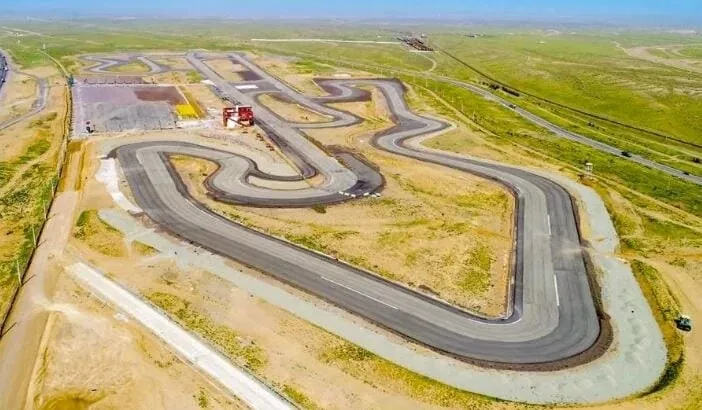
Despite stated ambitions and very real infrastructure, the probability of seeing Formula 1 take place in Iran in the short or medium term remains extremely low, but the project exists or has existed: a story.
Read more Andrea Stella at Ferrari? The «fake news» of the week: why we shouldn’t get carried away
Iran has built a 5-kilometer circuit named Zarandieh International Autodrome, located in the desert near Tehran. The track was designed to meet FIA homologation standards.
The project was carried out by the British company Apex Circuit Design, with a layout inspired by certain iconic sections of reference circuits such as Spa-Francorchamps and the Nürburgring.
A promising layout
Located at 1 100 meters altitude, the circuit features a 22-meter elevation change and a series of fast, fluid curves, particularly in the high-speed sequence between turns 12 and 17. According to local media, the layout would be capable of hosting Formula 1 competitions according to FIA standards.
Over the last decade, Iran has appeared intermittently in discussions surrounding the expansion of Formula 1, most recently through concrete circuit projects. However, no Grand Prix has ever taken place, and this prospect seems more unlikely today than ever in the current context of the war with the USA and Israel.
The Qeshm Island project
The most notable project dates back to 2015, when Iranian officials announced their intention to build a Formula 1 circuit on Qeshm Island, located a few kilometers off the country’s southern coast in the Persian Gulf, near the famous Strait of Hormuz, which is the subject of all current strategic stakes.
Masoud Soltanifar, then vice-president and head of the cultural heritage and tourism organization, explained that the country’s youth and growing interest in automobiles made Formula 1 a logical evolution.
Read more Williams poaches from Mercedes AMG: James Vowles’ network in action
On paper, Qeshm offered a spectacular setting: beaches, mountains, forests, deserts, and salt caves, as well as significant biodiversity with coral reefs and protected areas. But building a circuit is not enough. The F1 also requires commercial, logistical, and political guarantees: accessibility, hosting costs, aviation infrastructure, regional stability. We are far from that…
The Zarandieh circuit
Alongside Qeshm, a more concrete project emerged near Tehran: the iLand Race Resort complex (photo above), integrated into a science and technology park southwest of the capital.
Built on 75 hectares at an altitude of approximately 1 100 meters, the layout features a 22-meter elevation change and a notable fast sequence between turns 12 and 17. The complex was also to include a club, an exhibition center, karting facilities, and a road safety school.
Even in the event of an upgrade, other obstacles remain: the location (about 50 km from Tehran), logistical constraints, and above all, the geopolitical situation.
An unfavorable geopolitical reality
In the current context, international tensions involving Iran greatly reduce the probability of a Grand Prix. Formula 1 relies on a global ecosystem — sponsors, broadcasters, teams, logistics — which requires stability and predictability.
However, the Middle East already hosts several well-established races, notably in Bahrain, Saudi Arabia, Qatar, and Abu Dhabi, offering modern infrastructure and solid international hubs. Consequently, the commercial interest of a more complex market appears limited while candidates for Grands Prix are lining up at the door.
Read more Mick Schumacher’s laborious IndyCar debut: still a lot of work to do