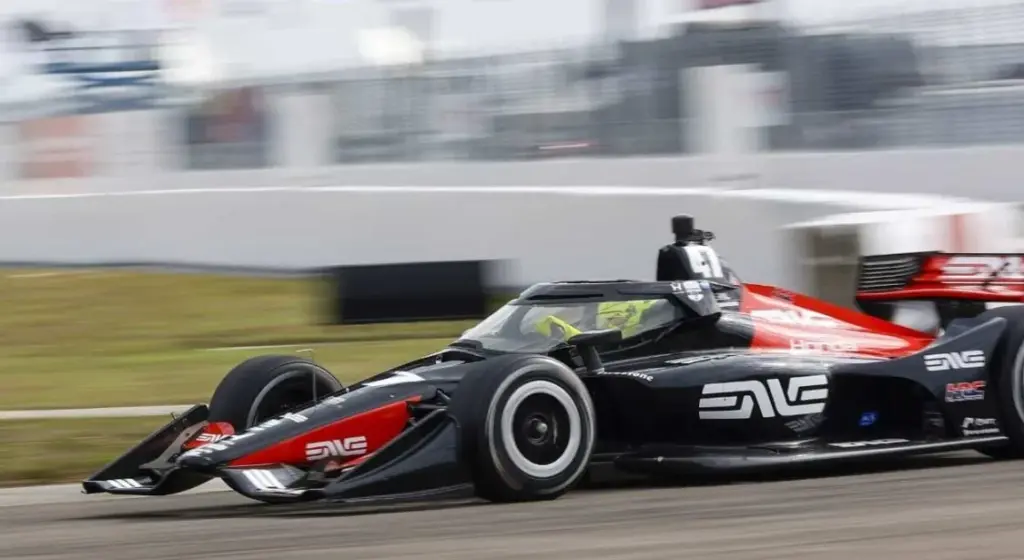
For Mick Schumacher, the move to the IndyCar Series was not just a simple change of championship, but a brutal immersion into a totally different environment.
After his first races across the Atlantic, the German did not look for excuses and gave a lucid assessment: “I thought I was ready, but I wasn’t.”
Accustomed to the highly structured standards of Formula 1, Schumacher was immediately faced with a culture shock upon his arrival on the starting grid at St Petersburg.
Another world
The atmosphere there is radically different, with direct public access to the pit lane before the race, plunging the drivers into a much more chaotic and immersive atmosphere. “People surround the car, there are a lot of people and I didn’t really know what to do,” he says, describing an initial disorientation before finding his bearings.
Beyond the atmosphere, it was also the technical environment that required rapid adaptation. The switch to the imperial system — miles, PSI, degrees Fahrenheit — was an unexpected challenge for a driver trained in the European school. “That was the hardest part,” he admits with humor, highlighting how much reflexes must be entirely recalibrated.
His baptism of fire in racing was particularly brief, as he was eliminated after only a few corners during the opening round. A frustrating episode, but one he puts into perspective by highlighting the learning accumulated: drawing as many lessons as possible, even from a shortened weekend, remains essential in this adaptation phase, according to him.
Good qualifying for his first oval
However, it was on the Phoenix Raceway oval that the reality of IndyCar hit home hardest. Qualifying in a promising fourth place, Schumacher was quickly overtaken in the race, discovering the very specific dynamics of the pack on an oval. Contrary to what he knew, single-lap performance guarantees nothing in race conditions, where slipstreaming and traffic movements constantly reshuffle the deck.
Read more Priority to Formula 2 for Colton Herta, who skips the Indy 500: a significant choice
“I wasn’t ready for that,” he admits. “It was very chaotic, with cars everywhere.” After a difficult start, he nevertheless managed to stabilize his pace around the top 10, before a problem during a pit stop compromised his result again.
Mentored by his coach Ryan Briscoe, Schumacher immediately began an in-depth analysis. The conclusion is clear: with the experience gained, he would approach the race very differently today. An awareness that illustrates the scale of the learning curve he is facing.
The prospect of the Indy 500
Despite the difficulties, pressure does not seem to be a problem for him. On the contrary, he fully embraces it: “No one can put more pressure on me than I put on myself.” A statement that reflects a well-anchored state of mind, forged by years spent in the spotlight.
This rapid skill development is all the more crucial as the major deadline approaches: the legendary Indianapolis 500. After the Phoenix experience, Schumacher now knows that the challenges awaiting him on this 2,5-mile oval will be on a whole other level.
Disappointment at Barber
His more recent weekend on the Barber Motorsports Park road course, more familiar territory, was no simpler, with a 24th-place finish after starting 20th, while his team leader Graham Raham finished on the podium. But here again, the main point lies elsewhere: “I feel more and more comfortable every time I get in the car,” he explains, highlighting constant progress.
The goal is now clear: to reach a level where driving becomes instinctive, in order to focus fully on pure performance and car development. In a championship as dense and competitive as IndyCar, this ability to adapt quickly will be decisive in hoping to establish himself permanently at the front. Next verdict in the streets of Long Beach next week.
Read more Ferrari is preparing engine upgrades for the summer