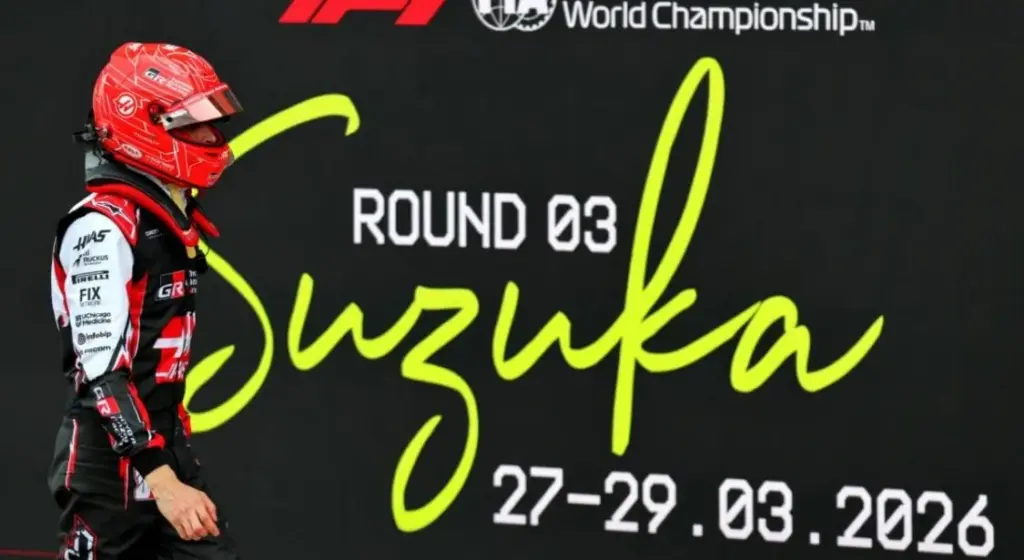
Frustration continues to grow among drivers regarding Formula 1’s new technical rules, and Esteban Ocon did not hide his annoyance after the Japanese Grand Prix regarding the overtake mode.
Read more Ferrari’s development work on the track or how teams take advantage of the break
The Haas driver even described the boost system dedicated to overtaking as a real nightmare, after a race where he found himself unable to make a difference despite his attempts.
Introduced as part of the 2026 regulations, the “Overtake” mode is intended to encourage overtaking by providing an extra 0.5 megajoules of electrical energy, allowing for a temporary increase in top speed in the same spirit as the DRS previously.
Side effect
On paper, the tool seems relevant. But in practice, its use creates a perverse effect: by activating this boost to overtake, the driver drains their battery and immediately becomes vulnerable on the following straight. The overtake can then be canceled almost instantaneously, and when two drivers use their energy simultaneously, the situation remains completely frozen.
This operation is increasingly criticized in the paddock, notably by Max Verstappen, who is already very vocal about the limits of these 2026 cars. At Suzuka, Ocon experienced it firsthand, stuck behind Liam Lawson for much of the second half of the race.
“I enjoyed the first half of the race before the safety car. But after that, it wasn’t fun anymore, clearly not pleasant,” he explained. “Using the boost was a real nightmare: if you use it, you actually go backwards.”
Read more «F1 doesn’t need Max Verstappen» warn the legends
Strategic reflection
Faced with this impasse, the Frenchman believes that drivers are forced to give up any offensive strategy, settling for maintaining a base pace without being able to build a maneuver: “You can’t really prepare an overtake, or try anything. Everything is too on the limit,” he regrets, highlighting a total loss of strategic control linked to energy management.
Until now, the FIA and the sport’s governing bodies have mainly focused on visible problems in qualifying, notably those paradoxical situations where drivers have to lift off in the middle of a fast lap. A key meeting is planned to analyze the initial feedback on these regulations, against the backdrop of concerns regarding high closing speeds, highlighted by Oliver Bearman’s accident at Suzuka.
Latent unease
But for Ocon, these adjustments only target a tiny part of the problem. He advocates for a much more global approach, particularly regarding the energy capacity of the cars: “I think it would be better to have a larger energy capacity, a bit like last year. For me, we are constantly lacking energy, and we can’t plan anything.”
While he acknowledges the efforts made, his assessment remains clear: “I understand the corrections for lift and coast in qualifying, but it’s maybe 1% of the solution. There’s still 99% to deal with.”
A statement that perfectly illustrates the current unease surrounding this new technical era, where energy complexity seems to take precedence over the very essence of driving and the spectacle on track.
Read more Lance Stroll as a guest star at Le Castellet in GT3 this weekend: career change in sight?