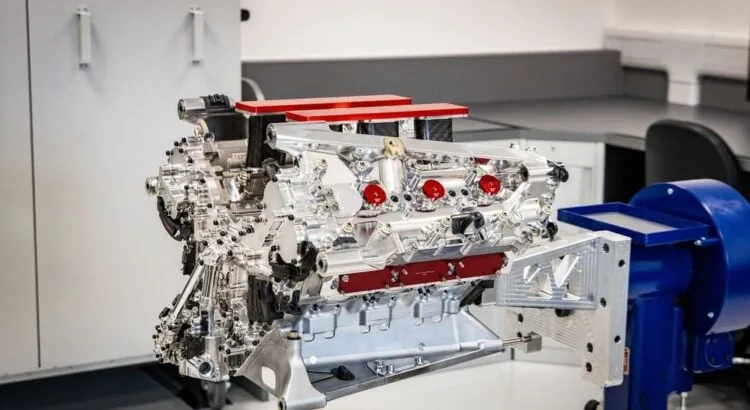
The possible abandonment of hybrid engines in F1 by 2031 constitutes a major strategic turning point, both technical, political and economic: the regulations are in eternal evolution.
Read more Catalan Week
Since 2014, the discipline has been built around extremely complex power units, combining internal combustion engines and advanced electrical systems.
While this architecture has allowed for impressive gains in energy efficiency, it has also generated very high costs, a complexity difficult for the general public to understand, and recurring criticism regarding the lack of spectacle, notably in terms of sound and the weight of the cars.
Simplifying an overly complex regulation
The idea of a return to turbocharged V8 engines powered by synthetic fuels is based on a logic of simplification and repositioning. Technically, removing all or part of the hybridization would significantly reduce development and operating costs, while making the cars lighter.
In terms of spectacle, this would meet a strong expectation from some fans and drivers, who miss the rawer and louder character of previous engine generations.
Synthetic fuels play a central role here, as they offer an alternative that allows for the retention of internal combustion engines while achieving theoretical carbon neutrality, which is essential for maintaining consistency with the discipline’s environmental goals.
Read more Lando Norris worries Brundle: he does not control the power deployment when he drives
Audi and Honda in disagreement
However, behind this direction lies a real power struggle between engine manufacturers. Manufacturers like Audi or Honda entered Formula 1 precisely because of the hybrid dimension and its technological relevance for electrified production vehicles. A shift toward a predominantly internal combustion engine could weaken their position and call their strategy into question.
Conversely, players like Ferrari, historically attached to the emotion and sound identity of engines, might welcome this return to a simpler and more expressive architecture. Mercedes, for its part, finds itself in an intermediate but strategic position, having built its initial dominance on hybrids and thus potentially slowing down an evolution that would reduce this competitive advantage.
Towards an intermediate solution?
This reflection is also being carried out at the highest level of F1 governance. FIA President Mohammed Ben Sulayem has expressed support for simplifying engines and returning to more spectacular solutions, while the discipline’s CEO, Stefano Domenicali, must arbitrate between sporting attractiveness, economic viability and maintaining manufacturer commitment. Their challenge is to avoid the pitfalls of the 2014 regulations, deemed too complex and too costly, while maintaining technological credibility.
In reality, the feasibility of this project will depend on several determining factors: the ability of synthetic fuels to become economically viable on a large scale, the evolution of public expectations, and above all the ability of the various engine manufacturers to find a compromise. At this stage, a pure return to a thermal V8 remains possible but not guaranteed.
The most likely scenario, from a technical and political point of view, would rather be an intermediate solution combining a turbocharged V8 engine with simplified hybridization, allowing for a balance of spectacle, cost reduction and the maintenance of a minimum of technological relevance for manufacturers. The debate is open!
Read more No real progress for Williams before the summer break: having to be patient