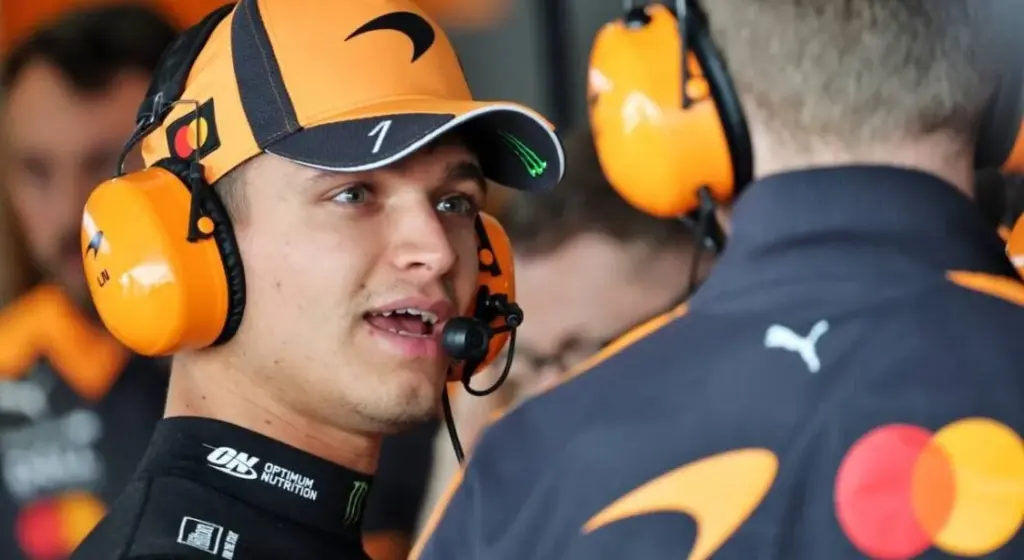
In the end, it wasn’t the spectacular incident between Oliver Bearman and Franco Colapinto that worried Martin Brundle the most, but a much more revealing statement from the reigning world champion.
Read more No real progress for Williams before the summer break: having to be patient
The McLaren driver explained that he had indeed overtaken Hamilton’s Ferrari in spite of himself, simply because of the automatic deployment of the battery, which he could not control.
A situation he describes as being forced upon him: the power arrives, he overtakes… then immediately finds himself vulnerable, without energy, letting his opponent take back the advantage.
The danger of the system
For Martin Brundle, the respected Grand Prix commentator on Sky Sports F1, this statement poses a fundamental problem. It calls into question one of the historical principles of Formula 1: the driver must have total control of his car. « The driver must drive the car alone and unaided », he recalls, worried to see behaviors appearing that he likens almost to unpredictable reactions from automated systems.
According to him, the relationship between the throttle and the power delivered must remain direct and linear. Any form of intervention or complex logic in the deployment of energy goes against the very essence of driving. He therefore clearly calls for simplification and a return of control to the driver, even if this requires significant technical adjustments.
Beyond the sporting aspect, Brundle broadens the debate to the question of safety. He believes that the FIA must react quickly, especially since the drivers have reportedly already expressed their concerns, possibly via the GPDA. According to him, failing to act would expose the governing body to heavy responsibilities in the event of a serious incident.
Priority to safety
He also establishes a hierarchy of safety priorities, placing spectators first, then track marshals, teams, and finally drivers. A vision that may be surprising, but which underlines the importance of prioritizing the protection of those who have not chosen to take a direct risk by participating in the competition.
Read more Max Verstappen considers rallying too dangerous: «Not for me»
On a technical level, Brundle points to a structural problem linked to the new regulations: the massive increase in electric power, combined with imperfect battery management. As a result, energy is deployed in a way that is difficult to control and runs out too quickly, especially on long straights. « We are between a rock and a hard place », he summarizes, referring to equipment he considers still insufficiently developed despite warnings known for several years.
He nevertheless remains convinced that adjustments are possible, notably to smooth out these effects and make the behavior of the cars more predictable. Changes could thus occur quickly, potentially as early as the next race in Miami.
Viewers’ opinion
Interestingly, despite the criticism from some drivers and observers, Brundle highlights that fan sentiment is much more positive than one might think. Through his informal exchanges, he notes that many appreciate the close racing offered by this new regulation.
« People are having fun and love these battles », he says, highlighting a gap between the paddock’s discourse and public perception.
A contrast that perfectly illustrates the current dilemma of Formula 1: finding the right balance between technical innovation, driver control, and on-track spectacle.
Read more Lewis Hamilton warned at Ferrari after being dominated by Charles Leclerc in Japan