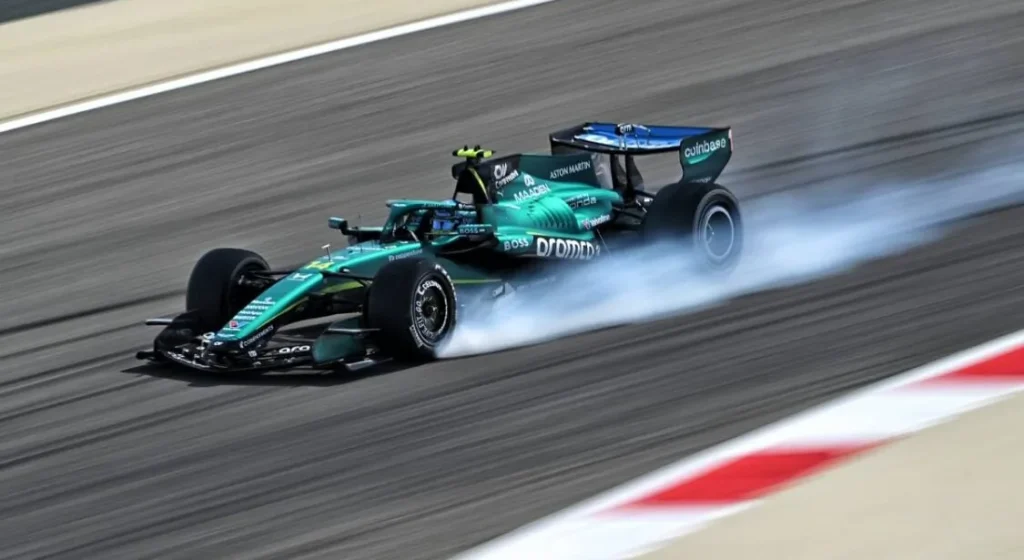
It’s a crisis at Aston Martin, as we’ve known since the Sakhir winter tests, and solutions are not in place for the first Grand Prix: a double retirement after the formation lap?
Read more Suzuka as Plan B: F1 considers two Grands Prix in Japan in case of cancellation in Bahrain
A few days before the Australian Grand Prix, Aston Martin F1 Team and Honda are approaching the season opener in a climate of high technical tension.
The new Japanese power unit is going through a major reliability crisis, to the point that the hypothesis of a voluntary double retirement in Melbourne is already circulating internally to preserve components.
Critical reliability from pre-season
The difficulties date back to the tests in Barcelona and then Bahrain, where abnormal vibrations were detected. These caused damage to the battery, prematurely ending a race simulation for Fernando Alonso after 23 laps. The AMR26 was never able to complete a significant stint: 14 laps was already the longest continuous sequence achieved before the breakdown.
The problem, identified as excessive vibratory stress on the battery pack, has not yet found a definitive root cause. Lacking a structural solution, Honda has prepared temporary countermeasures — on both the engine and the chassis — which will be evaluated during free practice in Melbourne. These sessions will serve as a full-scale laboratory.
In the immediate term, the engine is running in a degraded mode to limit the risk of failure, which directly affects performance. The priority objective is not the raw result, but the accumulation of data and controlled mileage.
Strategic risk management
A conservative strategy is not excluded: entering both cars at the start and then recalling them after a few laps to avoid a more costly failure. An embarrassing decision for a partnership presented as strategic, but one that could preserve components for the following Grand Prix in China, as part of a back-to-back sequence.
Read more Weather forecast for the 2026 Australian Grand Prix
The regulatory context complicates the situation. The engine homologation date set for March 1st by the FIA freezes the reference specification. Upgrades remain authorized for reliability reasons, under federal control and within the limits of the budget cap, but Honda admits it must dip into its development allocation earlier than planned, potentially at the expense of future performance.
The case of the MGU-K and ADUO
Rumors also mentioned a limited capacity of the MGU-K to operate at full power (250 kW or even 350 kW). Honda refutes a technical inability: according to the engine manufacturer, the restriction observed in Bahrain was a conservative choice related to reliability and a lack of available parts.
Improvement prospects are also framed by the ADUO (Additional Development and Upgrade Opportunities) mechanism, based on an engine performance index evaluated over three periods (races 1–6, 7–12 and 13–18). A gap between 2% and 4% grants the right to an additional upgrade; beyond 4%, two upgrades are possible, with correlated adjustments to dyno testing and authorized spending. For Honda, this system could become crucial, provided the technical base is first stabilized.
Newey gives himself six months
According to several sources, Adrian Newey gave a particularly frank speech to the Silverstone staff: “There is no reason to celebrate and the turnaround could take five to six months. I have a plan and I will get you out of this.”
Newey and team coordinator Andy Cowell then traveled to Japan, to the Sakura technical center, to oversee vibration tests on a full monocoque dyno, a sign of a systemic approach aimed at understanding the chassis–power unit interaction.
The crisis occurs in a tense geopolitical context in the Middle East, where a refinery operated by Aramco — a major sponsor and fuel partner of Aston Martin — was recently damaged before a resumption of operations announced by Saudi authorities.
Read more Piero Ferrari tempers optimism despite the Scuderia’s favorite status