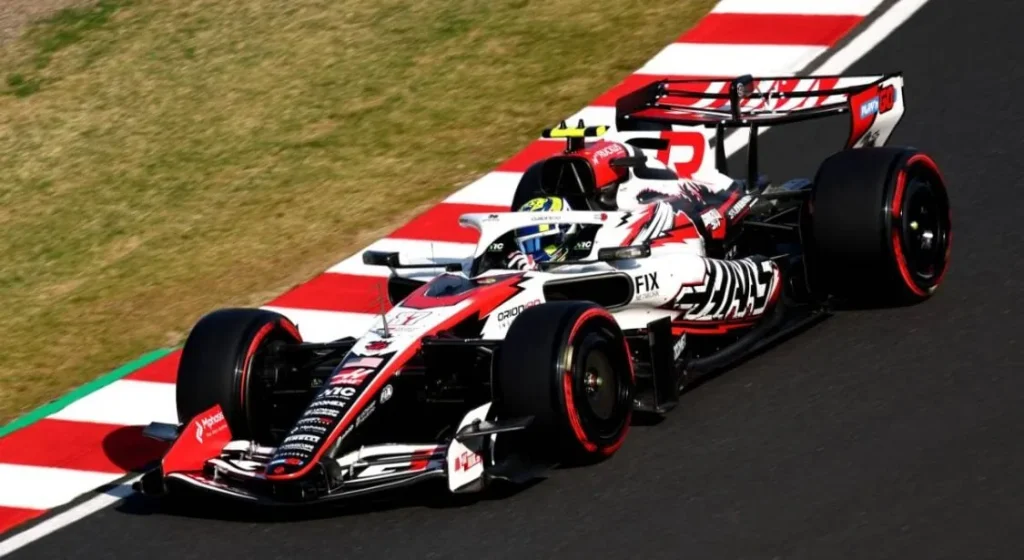
Oliver Bearman is establishing himself as one of the revelations of this early 2026 season: an authoritative leader in the midfield, the young Briton has maximized every racing opportunity with Haas F1 Team.
Read more Honda: «acceptable» vibrations on the Aston Martin for this weekend
The young Briton’s performances in the first two Grand Prix races have allowed him to score 17 points for his team so far on his own.
A performance that is putting pressure on his teammate Esteban Ocon, who is currently lagging behind, whether in terms of success or pure pace.
A quality package
As he approaches his third race of the season, Bearman remains faithful to a measured approach. Far from getting carried away, he primarily highlights the work of his team, which has provided him with a particularly refined single-seater. The Haas driver especially emphasizes the quality of the technical package: an efficient chassis, solid aerodynamics, and a car overall easier to exploit than last year’s.
« The chassis and aerodynamics are fantastic. The guys did a great job. The team provided us with a good car from the first race. We made a big step forward during testing and the car has improved a lot since », he points out.
Thanks to these improvements, Haas has established itself at the forefront of the midfield, and Bearman doesn’t hide his pleasure behind the wheel: « I’m having a blast. »
A still confusing regulation
While the competitiveness of the VF-26 provides a solid foundation, the young driver nevertheless points out the challenges imposed by the new 2026 regulations, particularly in terms of energy management.
Read more Franco Colapinto fans have harassed Esteban Ocon online, FIA reacts
The reduction in energy recovery significantly complicates driving, forcing drivers to rethink their approach. Bearman notably mentions a loss of approximately one megajoule compared to simulations, which requires extended phases without available energy.
In this context, certain traditional reflexes become counterproductive. In qualifying, pushing harder no longer guarantees a performance gain, quite the opposite: « On my last lap in China, I made my best corners, but I was two tenths slower. Sometimes going faster through the corner and accelerating earlier disturbs the car and loses time », he explains.
A particularly frustrating phenomenon, accentuated by fine battery management because a few percent less energy can cost several tenths on a straight: « It can come down to 3% of throttle. I lost two tenths simply because I had 5% less battery », Bearman details.
Result: qualifying becomes more of an unprecedented balancing act, where aiming for 100% performance can paradoxically make a lap less effective: « We’ve always been taught to push to the maximum, but today, it’s better to drive at 99% and be consistent. That goes against our nature », he acknowledges.
Suzuka and Monaco in sight
On a demanding track like Suzuka, these parameters could further complicate matters. Ninth on Friday, Bearman remains ambitious, with the logical objective of a third consecutive top 10, or better if circumstances allow.
Regarding Monaco, the Briton is more optimistic. The circuit’s profile, with its many braking zones and short straights, should limit the impact of energy constraints: « It may be one of the circuits closest to what we had in the past », he anticipates.
Read more Pedro De la Rosa : Wheatley won’t come to Aston Martin… for now