The 2026 Formula 1 season will see its first Sprint weekend during the second round of the championship, at the Chinese Grand Prix held on the Shanghai International Circuit.
Read more The Chinese Grand Prix TV schedule
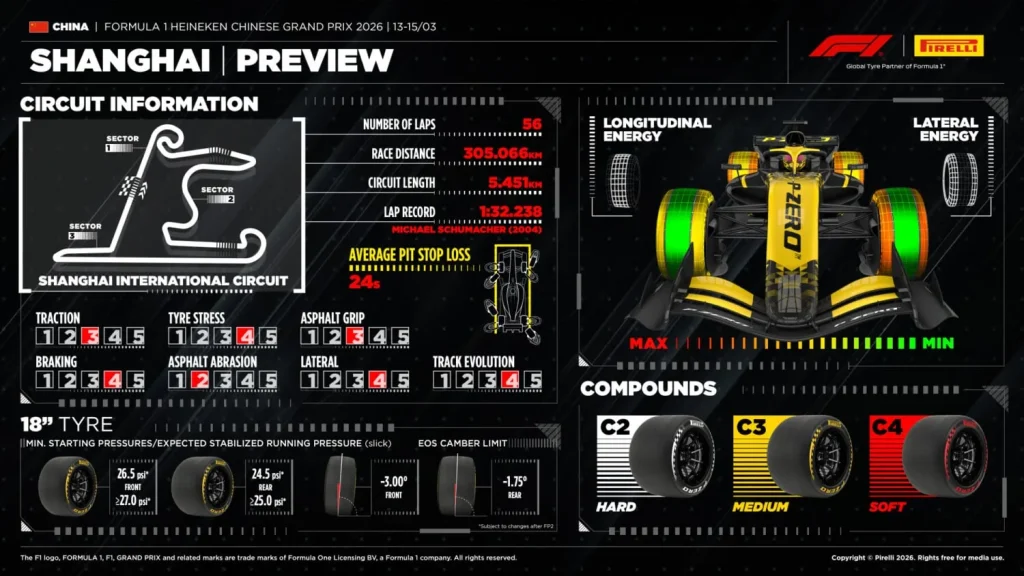
As last year, the first of the six Sprint races planned this season will take place on Saturday over a distance of 19 laps.
The tire choice remains identical to that used since the circuit’s return to the calendar: Pirelli will provide the different C2, C3 and C4 compounds to tackle the 5,451 km of the Chinese track (see table below).
Delicate tire and energy management
The Shanghai circuit, whose shape recalls the Chinese ideogram « shang » meaning « upwards », features two long straights and sixteen corners. The first connects turn 13 — slightly banked — to turn 14, while the second, over a kilometer long, hosts the starting grid.
Some sections are particularly fast, like the S-sequence of turns 7 and 8, while others are very slow, notably the combinations of turns 1-3, 6 and 14. This alternation of fast phases and heavy braking puts the tires to the test and complicates the management of energy recovery with the new 2026 power units.
Read more Ferrari prepares the «Macarena» rear wing to challenge Mercedes at the Chinese Grand Prix
Observers will be attentive to the drivers’ ability to avoid wheel lock-ups at corner entries, a frequent phenomenon observed during winter testing in Sakhir, where some braking zones are comparable to those of the Chinese track.
An asphalt still evolving
The track was completely resurfaced in August 2024. This new surface had significantly increased grip and allowed for faster lap times during the Grand Prix’s return in 2025. On the other hand, the smoother surface had caused graining, especially on the front axle, which was particularly penalizing during the Sprint race.
However, this phenomenon had decreased on Sunday thanks to the track’s evolution over the weekend. One year later, the asphalt should be slightly more worn: grip could be a bit lower, but the risk of graining could also decrease.
According to lap time simulations carried out by the teams, the expected performances are close to those of last year. Despite completely different cars with the new technical rules, energy management zones seem to compensate for the drop in raw speed of the 2026 generation.
Read more Towards an F1 calendar earthquake? Bahrain and Saudi Arabian Grands Prix under threat